
|
Index
•
|
|
Welcome
•
|
|
|
The International Writers Magazine: Mexico
EXPLORING THE MAYAN GRANDEUR OF COBÁ
• Habeeb Salloum
Cancún, Mexico’s number one tourist resort, was barely beginning to awake when we began our journey to the ruins of Cobá - once a very important Mayan urban centre, 170 km (106 mi) away. That city was at the epitome of its glory and power from about 622 to 800 A.D., then slowly faded in importance until just before the Conquistadors came when it was abandoned. Now, as our mini-bus moved further and further southward, I became progressively excited, thinking of those renowned ruins that we were to explore that day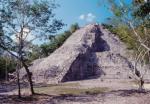
A short distance from the ruins of Tulum, the only Mayan city still inhabited when the Spaniards arrived, we turned on a narrow road to drive the last 40 km (25 mi) to Cobá. In about half an hour, the tops of the half-submerged seemingly strangled ruins, built on the shores of three shallow lakes in a rain forest appeared - ghostly in their beauty. It was like a mirage of the past Mayan civilization, but true to life.
Once a great trading city of some 55,000, it is the only Mayan urban centre built edging lakes. After its abandonment, it sank back into the jungle and almost disappeared. The dampness produced by rain, tree roots and vines, as happened to all Mayan cities, eroded most of its monuments, yet what still remains tell a story of past majesty and grandeur.
The remnants of 16 sacbés (white roads), of the 50 that once existed, radiating from the city, still can be seen. Built in a raised fashion above ground through the jungle, then plastered and polished, they attest to Cobá’s importance as a trading hub. These mostly straight roads were links to religious centres throughout the Yucatán. The longest was a 101 km (62 mi) scabé, without a single curve, which linked Cobá to Yaxuná - also once a large and important religious and trading centre.
Yet strangely, humans only used the sacbés. In spite of their progress in many areas, the highly advanced Mayans never invented metal, the simple door, employed beasts of burden or discovered the wheel. On the other hand, some historians assert that the Mayans did develop the wheel but because it was associated with a religious significance it could not be used by humans. This could be a fact since toys with wheels have been found in a number of Mayan ruins.
We walked into the ruins under the shade of a canopy formed by interlocking trees overhead. Clearly visible, edging both sides of the pathway, were still uncovered mounds of structures, looking like shrub studded tiny hills.
Of Cobá’s 70 sq km (27 sq mi) of ruins only 12% has been excavated, but what has been uncovered is an impressive testimony to the greatness of the Mayan builders. An intriguing reminder of Mayan glory, the ruins tell of the political and social power of one of the most important of the Mayan cities.
Suddenly, the very impressive 24 m (79 ft) high La Iglesia (Church Pyramid), crowned with a temple, loomed before us. We did not tarry long at this imposing structure which is the oldest in the city for our goal was the Nohoch Mul Pyramid - the loftiest of the Mayan structures in the northern Yucatán.
The partially excavated Juego de Pelota (Ball Court) was our next stop. However, after one has seen the huge Ball Court in Chichén Itzá, this one in Cobá appeared unimpressive. The ball game, very important in Mayan culture, was played with about a nine pound rubber ball which was propelled only with the hips to shoot it through a ring jutting from the side of the court. It is said, but not proven, that the winning team's captain was sacrificed so that his better-than-average blood would feed the ground and, hence, it would grow better crops.
As we moved along, the guide would stop and decipher some of the over 30 uncovered stelaes in the city. Some of them were dated and etched with figures and hieroglyphics and stood, with some thatched-roof covering, where they were discovered. A number commemorated important events such as accessions, alliances, births, death and marriage; others depicted great triumphs with the victorious king standing on his captives. However, all those we saw were so weatherworn that we had to rely on the guide to inform us of their message. When I asked the guide, "Why aren’t these treasures better protected from the elements?" He smiled, "Who is going put out the money? We have millions of Mayan artifacts."
Moving forward in sweltering heat, we stopped to survey a small rounded building, called the Wind Pyramid. According to our guide, the Mayans rarely built rounded structures and there are only 10 to 20 of this type of building in the entire Yucatán.
Past a preserved Section of a raised sacbé, part of the one to Yaxuná, we walked for a few minutes, and there before us towered the 45 m (148 ft) high Nohoch Mul Pyramid, standing high in all its glory. Soaring 12 stories above the jungle, it honors the Descending God and must have been a majestic sight in the days when it was still the home of Mayan priests.
Exhausted from the searing heat during the 1 1/2 km walk, I sat down perspiring profusely by the pyramid steps. Yet, even though it was midday, I still wanted to climb this renowned structure. Wearily and with great effort, I climbed three quarters of the way up the steps. Sitting down with water seemingly pouring out of my body, I looked around.
From my vantage point, as far as the eye could see, there was a panoramic view of the surrounding deep-green jungle. Below, amid the few excavated buildings, countless un-excavated tree-covered pyramidal structures poked up through the encompassing forest. It was quite apparent that the archaeologists had much work to do if Cobá is to show its true charms. However, I felt elated, experiencing the view for which Cobá’s pyramid is renowned.
Back in the air-conditioned bus, I felt satisfied. I had trekked through Cobá’s ruins, back and forth for at least three kilometers then almost climbed to the top of one of Mexico’s most grandiose pyramids. That night, in one of Cancún’s five-star luxury hotels, I smiled to myself, thinking of the guide’s words after I told him my age of more than four score years and trying to climb the pyramid in the scorching midday sun. "God is great. He protects his children, drunks, idiots and mad men like you."
IF YOU GO
How to Get There:
The best way to see Cobá is to join a tour group in Cancún - Cancún All Tours and Magic Tours are two good excursion companies who organize tours. If one wants to drive, the highways are good,
Facts About Cobá and the Yucatán:
1) A small car rents for about $60. U.S. per day but less if you bargain or are not fussy about the auto.
3) When travelling to Cobá or any of the other Mayan ruins - wear a hat and comfortable shoes and take sun block lotion.
4) Beware! It is a criminal offence to take artifacts or souvenirs from the sites or out of the country.
5) The official Mexican currency is the peso currently trading at around - 10.5 pesos to a US dollar - 9 pesos to a CDN dollar.
6) The usual tips for baggage handlers and bellboys is $1.00 per suitcase; maids $1.00 per day and 50 cents for washroom attendants.
7) When you leave Mexico there is a ‘Departure Tax’ of about $18.00 US per person but this tax is usually included in your airline ticket.
For Further Information, Contact:
In Canada contact the Mexican Tourism Board - 2 Bloor St. West, Suite 1502, Toronto, Ontario M4W 3E2. Tel: (416) 925 0704. Fax: (416) 925 6061. E-mail: toronto@visitmexico.com.
Also Toll free number: 1-800-44 MEXICO.
Web: www.visitmexico.com or E-mail: contact@visitmexico.com; in the U.S.A. 375 Park Avenue, Floor 19, Suite 1905, New York, NY 10152, USA. Tel: (212) 308 2110. Fax: (212) 308 9060.
E-mail: newyork@visitmexico.com
© Habeeb Salloum April 2006
habeeb.salloum@sympatico.ca
Nabataeans:
The Builders of Petra
Habeeb Salloum
More World Destinations
Home© Hackwriters 1999-2006
all rights reserved - all comments are the writers' own responsibiltiy - no liability accepted by hackwriters.com or affiliates.
