
|
Index
•
|
|
Welcome
•
|
|
21st Century•
The Future |
|
World
Travel•
Destinations |
|
Reviews•
Books & Film |
|
Dreamscapes•
Original Fiction |
|
Opinion
& Lifestyle •
Politics & Living |
|
Film
Space •
Movies in depth |
|
Kid's
Books •
Reviews & stories |
|
|
|
|
The International Writers Magazine: India
Every time I come to this country, the coexistence of countless languages, cultures and religions fascinates me. This has been the essence of Indian heritage and it is this diversity that fills every arena in India, making this country such a fascinating study.
Oddities of India
• Meera Manek
With a Muslim President, Sikh Prime Minister and an Italian-born Catholic as Head of the largest political party, diversity and tolerance appear to work hand in hand. Historical events have time and again contradicted the existence of tolerance, yet India has recovered with relative ease from religious conflict and instability.
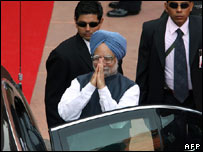
Image: PM Manmohan Singh celebrating the 60th Anniversary of Independence from the UK
More than this, however, it is the oddities of India that create her unique apparel. In 1996, when India celebrated her 49th anniversary of independence from British rule, the then prime minister HD Deve Gowda gave his address in the national language, Hindi, of which he did not know a word. A country once ruled by a man who did not understand the national language, a country in which this language is not understood by half the population and which now has a Muslim, Sikh and Italian within her political fortress – only in India.
Indian cities are invariably a conundrum to the outsider; harmony in contradiction is possible. When I look out of a room window from a glorious hotel, I see a slum area, beggars clothe the richest streets, and I walk next to a man who spits loud and clear with red-stained lips from the tobacco-filled leaf he chews. India is home to more than a quarter of the world's poorest people, and yet it is the world’s 11th largest economy. It is the sixth largest emitter of carbon dioxide, yet millions in India have no steady electricity supply.
There could never be an archetypal Indian. I overheard an Asian on the train last week saying, "he’s a typical Indian", but what does that mean - that all he wants to do is business or that he is rummaging through a pile of photos to choose his bride? Well of course that’s not true even as a generalisation. A comment like that could spark a hot debate but would always be missing the point.
Travelling from the tip of the Indian land to the most Southern point, the fair complexions that look almost foreign begin to fade into shades of wheatish-brown, until I reach the South, where the effect of extreme heat can be seen in the darkest of Indian skins. North to South, hair progresses from fine to thick and eyes shape changes, I pass through 18 official languages and 845 dialects, culture and religions are shuffled in every pocket of India, and even identity cannot be defined.
"I am an Indian", we say proudly (now that being Indian is actually a cool thing) and possessively as we live in a foreign country. But the villager in Gujarat identifies himself as only a part of that tribe, the worker in Bangalore sees himself as part of the growing middle-class and the school teacher from Karnataka sees herself as a South Indian. Identity and culture in India is wide and intricate; it can only be understood through analysis of each strand that creates the tapestries.
New York and London are a blend of cultures, but the cultures that compose India exist separately on a palette and complement each other to paint a colourful and vibrant India.
Mumbai market vendors
a league of their own
Meera Manek
Stall after stall of flowers greet me as I enter a chaotic street in Bhuleshwar, one of Mumbai's oldest markets
More World Travel
Home© Hackwriters 1999-2007
all rights reserved - all comments are the writers' own responsibiltiy - no liability accepted by hackwriters.com or affiliates.