|
Index
•
|
|
Welcome • |
|
About Us • |
| Hacktreks Travel • |
| First Chapters • |
| Reviews • |
| Dreamscapes • |
| Lifestyles 1 • |
| Lifestyles 2 • |
|
|
The International Writers Magazine: Fly Fishin' Montana way...
It’s a Hopper Kinda Day
• Jeffrey Beyl
You know how it is sometimes when you’re sitting in a restaurant and you overhear conversations from the surrounding tables. Who can help but listen in a bit, especially if you’re on a fishing trip and the other patrons are discussing how they did that day. The scenario goes something like this; the waiter walks up to the table to take their order and puts forth the big question, "So, how’d y’all do today?"The answers run the gamut from, "Oh, we knocked em’ dead" to "Well, we hate to admit it but we got skunked" and everything in between. Now, fishermen are a naturally competitive bunch. We always want to know how the other guy fared so as to compare our own success rate.
We were in Montana, my father and I, on one of our annual fly fishing trips. We always use the same guide. We were introduced to him several years ago through a friend of my father’s and now we cannot imagine fishing with anyone else. On this trip we had fished the upper Madison River for a day, outside a little town called Ennis. But most of our time was spent floating down the awe-inspiring Yellowstone River.
The river is aptly named for its walls of yellow-colored rock. Rhyolite, a brownish volcanic rock which turns yellowish through chemical action and thermal heat, is the result of explosive volcanic eruptions and the cooling of viscous lava. It is common in and around Yellowstone National Park through which the river flows.
National Geographic Magazine once called the Yellowstone "the last best river". The river flows some 670 uninterrupted miles from its origin in Wyoming to its confluence with the Missouri River near the Montana, North Dakota border. The river flows in a basically northward path through the majestic Yellowstone National Park, over a couple of spectacular falls and down along the magnificent Paradise Valley bordered by the Gallatin range in the west and the Absoroka (pronounced Absorka) range in the east. It then winds eastward toward the Missouri River, The valley, once the stomping ground of the Wooly Mammoth and Giant Bison, then dominated by the Crow Indians, is now habitat to grizzly bear, elk, deer, many species bird including eagles, hawks and osprey and of course, trout.
The trout in the Yellowstone River, mainly Rainbow and Brown, but also Cutthroat, Dolly Varden and several species of Whitefish, grow big, strong, wary, quick and beautiful. The average size is anywhere from 12 to 18 inches. But there also lunkers or "footballs" as we like to call them, lurking deep within the cool water. When they take your fly, man do you know it. On our third day fishing we were drifting the "Stone". We were doing okay, catching fish; we had tried so many different flies we still didn’t really know what they were going after. This is part of fly fishing, however, and we were doing our best and our guide, let’s call him Vince, was doing his best as the fishing guide, to figure out what was on the menu for the trout that day. Toward the afternoon we finally figured it out. Grasshoppers.
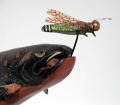
We had been hearing them clicking all day along the river’s edge but we were so caught up in our quest to "match the hatch" and nymph fish that we just didn’t pay attention to the grasshoppers being eaten smorgasbord. The next day we ventured back onto the river armed with every kind of grasshopper imitation we could find. We tried them all and caught fish and were having a great time. But I lost a fly in the rocks. Vince tied a fly called a "Foam Hopper" onto my tippet and told me to "Smack em’, love em’, and leave em’". This meant I was to cast the fly over to the rocks along the edge of the river, smack it down, and then jump it into the river. Once it was in the water I was to "love" it, in other words, accept it as is and leave it alone, letting it drift. Think about it a minute, a real grasshopper wouldn’t land in the water gently. This is a big insect. It would land hard, smack down then float, legs working, wondering where the heck it was until a big trout flashed up from the depths and engulfed it.
So that’s what I did and Wham! A Rainbow Trout streaked up, took the fly, broke the surface in a rushing leap and didn’t stop it aerobatic exhibition until we netted it, admired all 21 inches of its luminescent beauty and gently released it back into the water. "Now, that’s what I call taking the ‘hoppertunity’", said Vince.
Grasshoppers are terrestrial insects not normally thought of as food for the fish. When we think of the usual diet of a trout we think of aquatic insects; caddisflies, mayflies and stoneflies. Though sometimes certain species can attain pretty good size we usually think of these insects as being rather tiny and dainty. We speak of trout "sipping" baetis flies off the surface. But think a moment about a grasshopper. This is a big bug. I remember as a kid chasing 3 inch grasshoppers around the fields behind our house. We used to catch them and put them in big mayonnaise jars with holes poked in the lids to keep as pets. A bug this size makes a good meal for a trout, a few of them constitute a banquet. Couple this with the trout’s natural tendencies as a voracious predator and we have fly fishing extraordinaire.
It seemed that for the rest of the day we could do no wrong. Almost every cast worked, it didn’t matter it we splashed the fly clumsily down onto the water or landed it artfully and strategically. And the trout went nuts. We were catching bigger trout on a more consistent basis then we had ever done before. "It’s a hopper kinda day," said Vince (he has all kinds of little sayings; we call them Vince-isms). It became a quest for that "football" that we knew was down there somewhere. We were bringing in fish averaging 18 to 22 inches. Every strike was an impressive attack with the trout clearing the water by a body length or two. It was like films of Great White Sharks barreling into a sea lion and literally knocking the prey fully out of the water in a bursting, splashing, glorious display of power. The Rainbow Trout is one of the most impressive fish in the world for its proclivity to leap and fight.
That night at the restaurant, as we overheard the surrounding tables talking about how they were getting skunked, we remembered our foam hoppers, chewed and frayed by so many trout teeth, and we sat and ate in amused silence. "Should we tell em’?" I asked my father. "Naw, let em’ figure it out on their own, like we did." So we ate our dinner and spoke in a quiet hush so no one would overhear us reminiscing about how we had had a hopper kinda day.END
© Jeffrey Beyl October 2004
Seattle, WA
jab168@yahoo.com
World Destinations in Hacktreks
Home© Hackwriters 2000-2004
all rights reserved