|
Index
•
|
|
Welcome • |
|
About Us • |
|
|
| Hacktreks Travel • |
| First Chapters • |
| Reviews • |
| Dreamscapes • |
| Lifestyles • |
Hacktreks in Japan
Judo Masters in Tokyo
J.T. Brown
It was that 22 year-old, Jigoro Kano, who set out to make a new ‘sport’ derived from the traditional Japanese martial art of ‘ju-jitsu’An exquisite tango, a passionate embrace; and then they tumble down, bodies feverishly writhing, entangling. Their hot sweat commingles, a cheek buries itself in a heaving breast……..… then it is over. Glorious conquest for one. But for the other, there was no ‘sweet surrender’. This is JUDO.
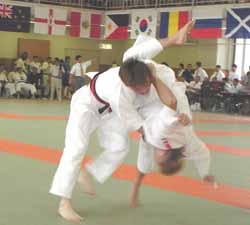
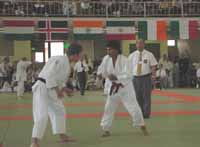
Just last month, the 2003 World Master’s Judo Championships opened in Tokyo, birthplace of this now very international sport. Surprisingly the first time ever for this event to be held in Japan, it was like a homecoming of sorts for judo. Now Dear Reader, even if you couldn’t give a hoot about a sport which, -above randy lead-in notwithstanding- might appear just to be a pair of squat-looking grunts in pajamas trying to push each other around (as opposed to sumo, where you have two even bigger grunts trying to push each other around in the nude), I promise that this is a story less about sport than it is about….stories. It’s about individuals, from those in the prime of their judo careers to some mighty rugged septuagenarians, all who came on a pilgrimage from every corner of the globe. Coming from Russia, from Brazil, from the Philippines, and everywhere in between, they had in common a devotion to an advocation. They made friendships, even when they could barely communicate with each other. And your humble correspondent, who attended every day of the week long tournament and spoke with many of the participants, witnessed to some truly amazing acts of courage and character (see both bottom part of article and link to accompanying photos.).
First, a little background on what all the fuss is all about.
You could argue that it is judo, not Walkmans or Corollas, which is Japan’s greatest export. Judo is now practiced in 187 International Judo Federation member countries around the globe. Just to put this figure into perspective, there are 191 member states of the United Nations. The sport has even penetrated France –that reluctant importer of foreign culture- to such a degree that according to the French Judo Federation, there are now more registered ‘judokas ’(judo practioners) in that country (580,000 people) than in Japan (just under 300,000). Not bad for a sport that started very inauspiciously in 1882, with a 22 year-old instructor and just nine original students.
It was that 22 year-old, Jigoro Kano, who set out to make a new ‘sport’ derived from the traditional Japanese martial art of ‘ju-jitsu’. Master Kano is now revered in dojos around the world as the father of judo.
Despite its image as a strenuous, rough and tumble discipline –after all, the ultimate ‘goal’ is to suddenly, and violently, terminate a match by slamming your opponent to the mat- judo is in fact as universal a sport as could be. Enjoyed by by little girls and boys who may begin at six years old, to senior citizens who take it up as a way to remain active in their golden years, there’s something in judo for everyone. Also, unlike many other a sport, judo allows for anybody with any kind of physique to practice it, and even excel. There are plenty of techniques and strategies to pick and choose from to best suit each individual, no matter how physically ‘challenged’ one might consider him- or herself. Simply having good leverage and balance is usually enough to beat brute strength and speed. But more than anything else, judo is a game of chess. It is a game of ‘seduction’. Seduce your opponent to make a move at you (or even away from you), give his or her momentum just a little extra helping nudge, and then yell "TIMBER" as you watch them fall. The same applies for a lot of the submission techniques(chokes, joint locks), though many judo hobbyists are not interested in that more hard core aspect of the art. And that’s fine. Even at the international competitive level, a judoka often declines to mix it up once the grappling takes to the ground. He or she gets up, walks away from the opponent and the referee resumes the match with both judokas in the standing position.
As I mentioned, I recently spent a week in the hallowed halls of the Kodokan, or ‘The Institute’, which is where Master Kano founded judo and which remains both the mecca and the most influential organization upon the sport today(the building complex has of course been rebuilt and expanded over the years). I got a taste of the special appeal that judo has on people by watching up close this year’s World Master’s Championships. (‘Master’, by the way, means any male or female who turns age 30 by the tournament’s opening day. ‘Senior’, would include anyone all the way from age 16 and up. Got that?). So many a judoka from around the world kept telling me the same thing: how they were fulfilling a dream merely by setting foot here in the house that Kano built, let alone by competing here. Many of the participants were further thrilled when the undisputed greatest living judoka alive, Yasuhiro Yamashita (former Olympic and World heavyweight champion, now Japanese national team coach) made an appearance one day to make the medal presentations. Everybody was squealing with delight. Even grown men in their late 50’ s(Yamashita, now retired from competition is only 46), gathered all around him, hoping to shake his hand and perhaps get their picture taken with him. But even Yamashita himself, a brave warrior who fought through pain with a damaged knee to capture the gold in the 1984 Olympics, must have been moved by some of the great individual acts of courage and greatness played out on the mat in this tournament. They were in abundance, happening at any given time on any of the four mats simultaneously holding matches in the Kodokan’s main hall, or ‘dojo’.
Here are just three:
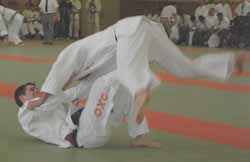
There was Alain Ruiz of Belgium fighting in the under 90kg men’s 35-39 age group: ripping or breaking something severely (ribs?) in mid-match, Ruiz refused to stop fighting. The Japanese referee and match physician literally had to pull him off the mat to stop him from trying to continue while seriously hurt (see photos).
There was Japanese men’s heavyweight Masaaki Kubo of the 50 to 54 age group. He brought along to the tournament with him the smiling picture of a dear friend and training partner who had just passed away from cancer six months earlier. His friend must have been smiling down upon him, because Kubo went all the way to become world champion in his age group. He kept the photo of his friend close at hand, even clutching it up on victor’s stand as he received his gold medal.
But by far, the most riveting moment of the entire tournament came when an American judoka by the name of Joseph Walters of the under 73kg men’s 60-64 age group won his second match by ‘ippon’(throw to the mat) over his Japanese opponent (and the eventual bronze medalist).
To compete at this level in judo -a rigorous sport where superb balance is crucial and the constant intention of your opponent is to try and momentarily destabilize just one of your two legs- is frankly a dream beyond the reach of most everyone. That Joseph Walters’ ONLY can fight on ONE LEG is unfathomable. But true. His left leg was blown off in the Vietnam War. Yet he competes. He asks no favors, save that the referee set aside his crutches for him while he hops up on his one leg to the starting position….and then fights. It is after the match and the obligatory bow, that the ref returns his crutches to him. I cannot tell you how inspiring and unbelievable it is to see this in person. We’re not talking about the Special Olympics here. This is the World Master’s Championships –the very strongest and best in the world per weight class and age group…….
Following that emphatic, glorious victory, Walters unfortunately was eliminated in the following round. But for a moment, the entire venue erupted like it did for no other match that week, when all witnessed just how dedicated and courageous one judoka could be.
© J T Brown July 29th 2003
{Please check out JT Brown’s companion website for all his Hackwriters.com articles, including two pages of accompanying photos for the above story.
http://www.geocities.com/themightykeyboard/index.html
jaytee_brown@yahoo.co.jpTokyo Life
Living here is cheaper than New York!
Home© Hackwriters 2000-2003
all rights reserved