

|
Index
•
|
|
Welcome
•
|
|
21st Century•
The Future |
|
World
Travel•
Destinations |
|
Reviews•
Books & Film |
|
Dreamscapes•
Original Fiction |
|
Opinion
& Lifestyle •
Politics & Living |
|
Film
Space •
Movies in depth |
|
Kid's
Books •
Reviews & stories |
|
|
|
|
VISIONS OF THE FUTURE - An essay
• Sam North
The Third Stage: 1919-1923 World War and the aftermath.
Prediction:
The First World War will be won by the chemists -
Poison Gas warfare will give decisive victory.
Most optimistic prediction: The war will be over by Christmas.
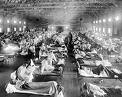
Image: Spanish Flu victims 1919
If the previous fourteen years had seen the transformation of the West to a modern consumer society with sophisticated tastes and ambitions, yet the inevitability of war was apparent all along with hindsight. The Great War eventually drew in all the modern nations and obliterated the lives of millions, liquidated fortunes, made others, and in this relatively short period, buried a hope that the world could learn to live as one and share the promise of the future. Indeed John Maynard Keynes who was an economic adviser at Versailles Peace Conference May 1919 made an astute comment. He wrote to a friend Duncan Grant - the painter: “ ...there is no food or employment anywhere and the French and Italians are pouring munitions into Central Europe to arm everyone against everyone else. All ask, not for food or raw materials, but primarily for instruments of war against their neighbours....They had a chance of taking a large....humane, view of the world, but unhesitatingly refused it...”
He returned to England to write a far seeing book entitled ‘Economic Consequences of the Peace’. The thrust of his argument rings true today - that the economy of all Europe and the world was one and inseparable. The legacy of a vindictive Versailles would be a contagion of riots and revolutions and dictatorships. “never in the lifetime of men now living has the universal element in the soul of man burnt so dimly”.
The visionaries could see nothing but endless war. H.G. Wells was most prominent, politicians such as Churchill shared this vision. The best minds were put to developing weapons of mass destruction. But out of the ruins came the fast flying aircraft, the durable car, the heavy truck, tanks, effective telecommunications, and radio. It established in the minds of leaders (as the Romans before them) of the necessity of effective road networks, and the need to be more accountable to the electorate. Modern UK politics was made more firmly based on democracy. The UK, diminished in what turned out to be a Pyhrric victory, convulsed and had to redefine its role in the world.
After the Armistice, there was negligible investment in housing infrastructure, yet the poor stock of UK housing was a primary cause of the general ill-health of the population. Housing starts from the end of the conflict to 1921 numbered only 150,000. Britain found itself with 13 million families and almost no coherent social plan. This number remained fairly static until 1939. Planning for the UK’s future became an obsession, yet the explosion of social housing building didn’t really take place until after the next war. For the time being, America was the clear victor and thanks in part to the inventiveness of its people and the dynamics of the war, underwent a rapid modernisation of its own infrastructure that would stand it is good staid later on in the century.
The painful birth of Soviet Russia would end up in a three-quarter century long painful straitjacket that may yet end in the total break-up of the many nations cobbled together out of the East. Another irony was the exclusive loathing of each others political system which lead to a wasteful duplication of scientific research that could have benefited the world at large.
The consequences of war resulted in an epidemic of TB and venereal disease. Demands for cures were many, but also the social stigma attached kept many in ignorance and lead to many thousands of unnecessary deaths. Visions of a society with cures for everything still pervaded.
The First World War ended, rekindling hope, initially dashed by a world wide flu-pandemic which killed around 50 million in 1918-1919. The affects of this pandemic have been massively understated and undercounted as no one was countin in Asian countries where the suffering was enormous. Arguably the HN51 virus ended the war as Germany was so weakend by it and the Americans too, it was killing more each day than the guns and new airplanes ever could.
By a lucky co-incidence, the modernisation of Europe that followed the war resulted in rapid employment for both male and female workers. The death of so many men had opened a niche for women in employment that they would be reluctant to relinquish. As modern technologies were applied to industry, using mass production methods pioneered at Henry Ford’s automobile factories, less men were need to do the work than before. Whereas in the last century men needed particular skills to earn a living, mass-production meant that jobs required less skills. Now any man could be trained to do quite complex but repetitive tasks. This, at once, robbed the working classes of the dignity of skilled labour and although they did not understand it as such, reintroduced ‘slave’ labour that was dulling and often hazardous.. Of course people got paid for their labour and more were paid than before, but mass-production robbed men of pride in their labour. The significance of this was masked by the sudden improvement in the economic landscape. Together with the war and the death of so many people between 1914 and 1919 (ending with the flu-pandemic) it obscured the real truth of modern technology. Less workers were needed in almost all areas. As it happened, the world was in a rapid birth-boom cycle, possibility the opposite of what was needed.
Post war, America went into an isolationist mood, with America First as a policy. It had responded tot he death of so many American on the European fields with a universal horror and American politicians had to promise that ‘never again’ would they sacrifice America’s young on the ‘Old worlds’ problems. The Edwardian globalisation of economies aided by a strong Great Britain and Empire had been replaced by vindictiveness and a collapse in the world economy. Each country fought for trade against the other and drove prices down. Everywhere the virus of nationalism grew alongside increasing bigotry. In the cracks it would spawn dictators who would promise the world and would be prepared to fight for it.
By 1924 unemployment was the rising spectre and in the UK where it reached almost one million, reflecting the collapse of orders for ships, coal and other manufactured goods, social tensions arose everywhere. Pundits were beginning to believe that capitalism was doomed and the Soviet Marxist solution would be the way forward.) Indeed, to observers on the outside of the Soviet experiment, the rise in steel production and manufacturing as a whole in the Soviet Union, in a society that had no industry at all in 1890 was considered to be remarkable. The truth about the persecuted populations, the elimination of the middle-classes, farmers, individual liberty and the introduction of death camps were hidden or the observers chose not to see.
Before the war, many of the most popular silent movies had been French. But this quickly changed and by 1919 the Cinema was firmly in American hands. (Two reasons for this. One the war prevented production and distribution and two the Americans bought up the distribution networks.) When sound came along out went subtitles and no one want to know about foreign movies in the USA. All the icons were either American or British - (Chaplin, Harold Lloyd. Clara Bow, Buster Keaton). Cinema became the established dominant entertainment medium. 'Theatre is dead' was the cry, but they had said that when photography was invented. Now dance music was sweeping the nation as phonographs grew ever more popular. The Roaring Twenties was about to begin.
False indicator of the future:
A geological survey of Saudi Arabia 1919-1923 undertaken by representatives of Shell Petroleum concluded that ‘no significant oil discoveries have been found or would be found in the region and recommended that the survey be concluded’. Source Shell Middle-East Survey Documents 1924.
John Maynard Keynes: ‘In the long term we are all dead.’
© Sam North 2000-2007
To continue reading Visions of the Future:
Introduction 1890-1914 1919-1923 1924-1939 1939-1946
2000-2010 - 2010-2050
Another Place To Die: Endtime
by Sam North and Sam Hawksmoor
The Next Great Flu Pandemic is coming. Are you prepared?
Reviews:
'It will keep readers in suspense, laced with gritty-gallows humor'
Charlie Dickinson
'Beautiful, plausible, and sickeningly addictive, Another Place to Die will terrify you, thrill you, and make you petrified of anyone who comes near you...'.
Roxy Williams - Amazon.co.uk
Fascinating, frightening and compelling, Another Place to Die is the ultimate page-turner which I guarantee will result in many late nights under the bedside light with you uttering, ‘just one more chapter!!’ Ian Middleton


< Back to Index
© Hackwriters.com 1999-2007 all rights reserved