

Welcome • |
About
Us • |
••• The International Writers Magazine - 21 Years on-line - Writing History Pt 2
Writing About the Dead
• Sam North
More on finding authenticity in writing history
Clearly it is easier for a work set in the 20th Century because we have so much archived and now digitised in every format. Records, paper, tape, film, photographs, almost anyone of note has been interviewed, however briefly, and if you want to know how say, Young Winston talked or carried himself, the clues are in his own writings and comments made about him in the newspapers of the time, even Punch magazine. But Winston is an easy target and no challenge at all. Finding facts and details on his wife Clemmie as a young woman would be a challenge worthy of a historical novelist, for less is known, her opinions reserved. However we do have her letters. Mary Soames had unique access to the personal correspondence between Winston and Clementine and these entitled ‘Speaking for Themselves’ was published by the Churchill Centre in New York in 1999. How she tolerated a man with such an ego was then never remarked upon in Tatler or The Times Diary. We do not have, as now, the benefit of a gushing Hello puff piece or a tabloid bust up on the lines of ‘Winston’s cigars in bed drove me over the edge’! This is for latter day historical research for the likes of historical novels about the Beckams and Rooney’s for the next generation of writers. With Clemmie we do know she spent most of her fifty-six years of marriage apart from her husband. This resulted in nearly 2000 letters exchanged between them from 1908 to 1964. We are fortunate that she also knew how to describe herself: I am stupid and clumsy, naturally quite self-reliant and self-contained’…she was wistful too, missing her husband often – ‘Time flies stealing love away and leaving only friendship which is very peaceful but not stimulating or warming.’
For the historical novelist looking to portray an important and lasting marriage that spanned a turbulent period in British history, these letters, are a rich vein in understanding both the characters and the way decisions were made in those times.
The nineteenth century is still a rich vein to explore. Good records, photographs for at least half a century and good sketches prior to that, receipts, unpaid bills, servants hired and fired, gossip noted, all buried in books and magazines and museums. In researching for my own book Diamonds – The Rush of 1872 I read many books around that period. America was in a post civil war economy undergoing rapid modernisation as the railways colonised huge spaces and drew cities together as never before. It is not just the research that matters here, I needed, as a writer, to become someone who instinctively understood, indeed thought with a 19th century values and attitudes, particularly American attitudes and conventions.
I like the little details. On family life in the Prairies by Leroy Judson Daniel’s in his book Tales of an old horse trader he writes:
‘My Dad was a Southern Gentleman. He would go in and sit on his chair, anybody who happened to be in his chair would get right out, no other chair would do for him. At four o’clock in the morning he’d give a war whoop and everybody had to get up, but he stayed in bed until breakfast was ready…’
Note that four o’clock and shudder.
Leroy in his ‘oral’ history chronicles something that barely gets a mention when we romance history. We record the arrival of the car and men like Ford or Chrysler or Hudson who developed and mass-produced them, but we never talk about the horses they displaced. It is offensive to some to talk of a holocaust when talking about horses, but men like Leroy Daniels were paid to despatch old and young horses to the slaughterhouses of Chicago by the million. If not to Chicago, then hundreds of thousands of horses and mules to the war front in Europe to die on the battlefields in the First World War. He made a fortune shipping them there and another bringing them back, but when they came home, the car had taken a grip and no one wanted them, so with Leroy’s help they were turned into dog food or stew for humans for shipment back to a starving Europe. Has it any relevance to the tale I was telling, perhaps not, but it was a reminder to me that sentimentality had no place in the 19th Century or the early 20th. Progress took no prisoners. When writing about characters that lived and breathed then, it is good to remember that.
The joy of research is finding books or obscure accounts of real people, perhaps not the heroes and people of note, but the one’s who do their bidding. Sometimes you uncover unpleasantries by today’s standards. There is a very poignant Canadian play Ernestine Shuswap Gets her Trout by Tomson Highway; It is about the Aboriginal concept of land ‘ownership’ and in this case, the rights of the Kamloops Indian Band. The British contempt for native Indians in Canada is illustrated in this play set in 1910. How a series of legislations about property rights of white immigrants, slowly and deliberately impoverished a proud people living off the land, until they become beggars and were dehumanised in the eyes of the settlers. Fences are built, cows removed from fields, intermarriage is declared illegal. Restricted from even fishing for salmon in their ‘own’ river or eating berries on the hills around them, they developed health problems they had never experienced before. History is also about remembering and uncovering unpleasant facts and bringing them alive to a new generation.
Research can also take you to places you hadn’t expected to go to and the writer can easily be side-tracked by a peripheral character whose history seems so much more detailed than the ones he or she may be writing about.
Such a case arose for me when writing Diamonds. One of the principal characters was a prominent banker in San Francisco called William Ralston. He plays a key part in the story but is not the focus of the book. Yet the more I read about him, the more I began to regret that the book wasn’t actually about him. Such a lot is recorded, whereas my own main protagonists were slim pickings historically speaking. Real, but they neglected to write their memoirs, leaving others, who plainly did not like them, to record their impressions of them. Ralston, having achieved an international reputation as a banker well recorded by George Lyman, who wrote Ralston’s Ring in 1937,Scribner - detailing his life and somewhat dubious business practices.
The discipline, of course, is to stick to the plan, not be distracted, but it is an awful temptation and I did indulge in describing Ralston's lavish home with 180 bedrooms all lit by gas, a first in California.
My own story takes the simple tale of how two men John Slack and Philip Arnold, found the first diamonds in the USA and parleyed it into a fortune. Ralston, Chief Cashier at the Bank of California is the linchpin of that story. In 1872 by George Lyman’s account, and records of the Bank of California, Ralston is San Francisco. Nothing happens unless he says so. He controlled the flow of gold and silver from Comstock via his ‘ring’ and pretty much strangled all other attempts of enterprises that he did not invest in. You could imagine him as ruthless, but no account I found painted him anything other than a good guy, caring, aiming to boost California at every opportunity. He didn’t cheat on his wife, or beat her, and was easily the most respected man (and hated by those whom he didn’t support) in the city. Even his former business partner Asbury Harpending in his autobiography (James H Barry Press 1913) who was eventually ruined by him, did not have a bad word to say.
But even so, he could not be the focus of the book. Yet the more one looked, the more remarkable he seemed. Born in Plymouth, Ohio to a rich ferry owner, at a time when the Ohio River was the only road north and south. However the ferry sank and the family fortune with it. Young William Ralston became a clerk on the Mississippi floating palace The Constitution (The Palaces were like Las Vegas Casino’s today but steam powered ferries).
Each day Ralston mixed with gamblers, pretty girls, bounders and pirates. The New Orleans of the 1840’s was pretty exciting and it is assumed that Ralston got a good training in all aspects of finance and vice. He certainly liked the good life.
When the gold rush news reached them in 1849 Ralston wanted to go, but didn’t have the ready cash. In George Lyman’s book he quotes Ralston saying‘ I want to go like a white man’, he declared, ‘And I think it will take about $300.’ He was 23, bronzed, brave, smiling, courteous, eager eyed, ready to put into practice what the river had taught him’.
Yet he did not reach the gold fields in the rush. At Panama he ran into old ferryboat friends Garrison and Feltz. They realised that there was money to be made ferrying men and their goods across the Isthmus (Between Panama and the Pacific) and it was here, back in the ferry business that Ralston made his first fortune as a ferry captain.
By the time my heroes met him in San Francisco in 1872 the former clerk from Ohio was the Donald Trump of his day and not only ran the Bank of California and owned the largest hotel in town and building another, still larger, he also lived like Napoleon in his mansion. In the 18th Century and earlier, naked ambition, greed, and life itself just had to be lived to the full, hang the consequences. Young men talked of adventure, making fortunes, or dying grandly to impress the ladies. At least that’s what Bernard Cornwell’s Sharpe would understand. A soldier on the make in a time of endless opportunities. Cornwell’s popularity is a combination of good writing, amusing stories, an indelible character who takes great risks and possesses ruthless charm, all set against a background of meticulous historical research.
A man who did not grasp opportunity was a plain fool. Risks were taken daily and generally it was assumed another opportunity would come tomorrow.
Ralston, in my book, is an older version of himself. The man made good, the gambler suppressed but not entirely. Attracted to each and every scheme that comes along with the instincts of a gambler, striving to stay on top of the heap as new challengers emerge.
When history recalls him however, if at all, they remember only that after a run on the bank he drowned himself in the bay. History belongs to the victors it is often said, but the historical novel belongs to the revisionists. The dead cannot sue for libel or seek redress but the writer has a duty to represent them truthfully, as the facts present themselves. The ethics of setting real characters in impossible situations with incredible characters is perhaps another debate, but the critical and popular success of Susanne Clarke’s novel would indicate that combining the real with fantasy will work, as long as the backdrop feel authentic. More recently we have revisionist history where everything is looked through the prism of political correctness. Traces of profiting from slavery condemn a character and they must be cancelled. Similarly with negative attitudes to gender or homophobia. Cecil Rhodes must fall they cry but he's not alive to defend himself or point out the prevailing attitudes of the time.
The late Jan Morris writes in Heaven’s Command – An Imperial Progress on the rise and fall of the Victorian Empire. Though not writing historical fiction, her research, as others who help us decode the past, can form basic tools for authenticity. Letters reveal so much about the times people lived in. (How delightfully convenient it was they found 1000 letters written by Lord Nelson in his bicentennial year). Writing the past as fiction means that one has to understand how they think and talk. Morris’s work on the Victorian Age enables understanding.
Morris quotes Ruskin: If we can get men, for little pay, to cast themselves against cannon mouths for the life of England, we may find men who will plough and sow for her – who will bring up their children to love her.’
Disraeli wrote ‘The English have a choice, a comfortable England or a great country, an imperial country, a country were your sons, when they rise, rise to paramount positions and obtain through their actions the esteem of their countrymen but command the respect of the world.’ His words that could have been spoken by any Roman Emperor.
If Disreali, a Tory Prime Minister and novelist (Sybil and Tancred) was colourful, which he certainly was, what was it that made him so attractive to voters? His politicies or his personality? Can one mine his books and speeches to find the essence of the man? Fortunately we have Dizzy’s own words to help us portray him: ‘A man can know nothing of mankind without knowing something of himself. Self-knowledge is the property of that man whose passions have their full play, but who ponders their results.’
The same for Shaw, Wells, Jules Verne. There are photographs, transcripts, letters, memoirs and their own words but without also bathing oneself in the social context of their times, it is impossible to recreate them with any authenticy. Bernard Shaw the playwright, according to Mrs Patrick Campbell, the noted actress, with whom he was obsessed, was cantankerous, witty, stiff, awkward, shy, and yet dextrous in his writing. In the play by Jerome Kilty ‘Dear Liar’ he brings their copious correspondence to each other alive and their stormy, often petulant demands. Shaw and Campbell are of their times and peculiar to it, but their sentiments and feelings are universal.
The fact is that the past is full of inconsistencies, racism and moral turpitude, ineptness, stupidity, fallibility, sexual perversion and the odd moments of luck and opportunity. Sometimes you get to thinking that these people had no concept that they would be found out and be judged. Luckily for us there was John Galsworthy to record it for us in his novel The Forsyth Saga which documented Victorian England and perhaps froze it for all time in aspic, as indeed A le Recherche Temps Perdu by Marcel Proust did for France.
For myself, the most useful histories are not written about Prime Ministers or about Captains of Industry, but by those who were there, the ordinary men and women recording each day, good or bad, often without judgement.
Bayard Taylor wrote his Eldorado – about his experiences in the Californian Gold Rush in 1849. It is a nice contrast with Mark Twain’s account ‘Roughing It’ ten years later. Horace Greeley of the New York Tribune commissioned Taylor to go west and record the events as they unfolded. The result is the not so accurate but fascinating record of the birth of a new California during the first gold rush. Hardship, greed, generosity, death and the law (or lack of it) described with much colour.
Through Taylor we discover not just the trials and tribulations of the gold prospectors but the astonishing profiteering of all those who would supply food, lodging, drink, tools and land to support the endless army of hopefuls that arrived. The history of the gold rush is exciting, simply because it is about risk taking, thousands winning the lottery overnight and even more thousands losing it all at a game of chance. Where prospectors went, whores, bankers and storekeepers followed.
Ships came in from all over the world. Taylor records that from China (and yes China was there from the beginning) one ship arrived filled with men armed with 250 prefabricated houses. Later historians would recall the resentment between the white incomers and the Chinese and the tensions that grew out if it. By 1851, as the easy money ran out, despair set in for those who hadn’t made it. 100,000 men and not a few women came in 1849, most stayed to become Californians for lack of any resources to go back. Curiously, although rising crime is often associated with the tales of the Gold Rush, the first recorded hold up didn’t occur until 1856.
Legends were quick to grow. ‘The honest miner’ by Joseph Henry Jackson recalls many of the stories of each new town as the gold fever took hold. Songs began to circulate that had a realist take on the situation:
Hangtown Galls are plumb and rosy
Hair in ringlets, mighty cozy,
Painted cheeks and jossy bonnets
Touch ‘em and they sing like hornets
Hangtown gals are lovely creatures
Think they’ll marry the Mormon preachers
Heads thrown back to show their features
Ha, Ha, Ha Hangtown gals.
But the reality was often quite different. Women with skills could command a price. Jackson cites a real advertisement from a Miners newspaper of the period.
A Husband Wanted
By a lady who can wash, cook, scour, sew, milk, spin, weave, hoe, (can’t plow), cut wood, make fires, feed the pigs, raise chickens, rock the cradle, saw a plank, drive nails. She is neither handsome nor a fright, yet an old man need not apply, nor any who have not a little more education than she has, and a great deal more gold, for there must be $20,000 settled on her before she will bind herself to perform all the above.
Address answers to Dorothy Scraggs with real name to PO Marysville
.
One wonders what kind of response she got and it does reveal quite clearly what a wife was supposed to perform to keep her man in those times.
Jackson reveals that contrary to general images of the gold rush, the average age of the ‘49’ers was between 18 and 35. It was tough up there. Not many men actually got rich or at least held onto their fortunes, despite the fact that some 600 million dollars was extracted by hand in the first few years.
An early death was common, there were no hospitals, and the doctors there were, were charlatans and the dentists often killers leaving their victims to bleed to death. Men would pay any price for a cure or to be rid of pain and it was rich pickings for the medical ‘profession’.
In Mountains and Molehills by Frank Marriot, he recalls a funeral of a preacher which went from pious to chaos as diggers discovered gold dust in the grave and the body was abandoned in the mad scramble to get their hands on the gold.
There was glamour in the mud too. Anyone looking for a subject to write on in the context of the gold rush should look to the travelling theatricals. In Nevada City in 1859, a Mrs Hayne put on Camille to great success one night. In the next ten nights she also staged full productions of Romeo and Juliet, Lucretia Borgia, The Lady of Lyons, The Love Chase, The Hunchback, and Camille for another three performances.
Miners were great supporters of the ‘arts’. Other nights they’d come to watch snake tamers, French Ballet, even Oscar Wilde reading prose. Civilisation followed the prospectors as small towns grew.
Image © Sam North 1997A favourite story took place in Silver City in 1863. It was told to me by a real estate agent keen to sell a particular 'Victorian style’property. It’s about a successful silver miner who imported a grand pre-fabricated metal Victorian Villa the Chollar Mansion. It’s still there, stamped corrugated tin, the wallpapered walls, and a stoop all around the whole house with its’ beautifully crafted fitting. It was erected and the rich prospector moved in. That very night, at a game of poker, he lost the house and his fortune. The new owner decided to dig a hole for an outhouse the next day and promptly fell into a mineshaft to his death. The house was clearly cursed and remains there, to this day 140 years on, currently for sale to one ‘lucky’ owner . In bringing the past back to life it is these little details, the very human elements of extraordinary lives that fascinates and enables the writer to animate the characters they bring back from the dead.
Historical Fiction is popular; one only has to look at the best seller list any month.
As Professor Allan Bloom writes in his seminal work – The Closing of the American Mind, ‘all the world was mad in the past, men always thought they were right and that led to wars, persecution, slavery, xenophobia, racism and chauvinism. The point of (writing history) is not to correct the mistakes and really be right but rather not think you are right at all. Not to take the moral stance is important. Today’s set of standards and morals do not fit comfortably with the mores of even 20 years ago, never mind 100, 200 years’
American history, as well as British is filled with unimaginable cruelties, with often a complete disregard for the environment, the welfare of mankind or the creatures that inhabit it. We suffer guilt because we displaced the native humans in America, Canada, Australia and more but we cannot undo it or even make amends.
Everything was in the name of progress. Only now we realise that Columbus and Hobart or Hudson or Captain Vancouver discovered nothing that wasn’t already there. Elsewhere was filled with indigenous people who had a history of their own, oral history, rituals and rules that we totally ignored. History is about battles, political and military. Even as I write this one is being fought now over the last of America’s pristine Alaskan forest where President Trump has decreed open to exploitation. An indelible act of aggression against the environment that will have devastating consequences if not defended. This is how the tectonic plates of human history are formed.
History as taught is often about heroes, royalty, pioneers, but perhaps only now we realise that there is another history, untold, unknown.
We are nations living in constant denial of history, distorting events because we no longer find them palatable. What stories will come out of Iraq? What will emerge from the ruins of Zimbabwe? Who will they blame? The tyrant or us for not coming to their aide?
Is history important?
Right now there are tensions between China and Japan over events that happened eighty years ago or more. Massacres that will not be forgotten. We in Europe have recently celebrated our 75th VE day when we found peace again after five years of war. We still recall the fallen from the First World War and the reverberations from that mindless war echo through everything we are and do. History is a part of us.
The 20th Century was one of constant displacement and people flowed like seismic waves across the world fleeing one oppression after another. America was filled in the previous two centuries with people fleeing starvation or religious persecution, The 21st century will also find upheavals as we learn to live or die by the consequences of decisions taken in the last and Climate Change will lead to massive drowning and population shifts in the second half of the century.
We can take lessons from history too. In New York of the 1880’s almost seventy percent of the population were immigrants, often Irish or German, living in unimaginable horrors. The census figures complied for New York by Jacob A Ruis gives in 1889 for example 349,233 immigrants landed at Castle Garden, New York. 43,000 of them Irish, 75,000 German, 44,000 Italian, all heading to live in the tenements, poor, often illiterate, often sick, vulnerable to all kinds of exploitation where the statistical death rate was 25 in every thousand.
The result of this immigrant explosion and the crime that came with it was all recorded in the amazing book by Herbert Asbury ‘The Gangs of New York’. Written in 1927 it shows a transforming society undergoing huge change, ruled from top to bottom by various levels of the elite. For the top of the heap you can read ‘The Age of Innocence’ by Edith Wharton in 1920, both stratas of this society have been filmed with a real respect for authenticity by Martin Scorcese. That these titles still resonate is testimony to the importance of historical fiction and records to make sense of our lives.
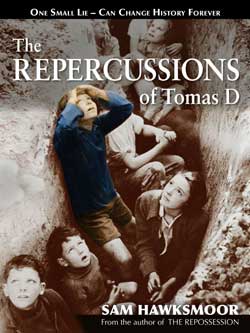
I started out by considering how it was we create the people of the past with any sense of authenticy, yet end up talking about the future. The society you encounter through research has rules; one must observe the beliefs and structures of that society, no matter how alien they may seem to the present. The duty of the historical novelist is to time-travel, discard the values of the present and become one with the characters you meet, be the sword in Sharpes’ arm, be the locomotive in Stephensons yard, be the target for German bombers, be the executioner and the heart, once stabbed, that stops beating. Recently I wrote a story about a contemporary young teen who finds himself back in the London Blitz. The Repercussions of Tomas D I was fortunate enough to have a mother who lived through it all and vividly remembered every indiginity. Bringing London of 1941 back to life was an amazing experience and respect for all those who survived it.© Sam North 2020
First Presented at the Great Writing Conference Portsmouth June 11th 2005
Editor of Hackwriters.com - Part One here
Spy/Romance thriller set during the Blitz in WW2 - Kindle download
The Repercussions of Tomas D
A Hero? Or Englands Greatest Traitor? USA Paperback here
'Disturbing and very poignant YA love story that presents a chilling alternate future for an England that lost the war.' Marcel d'Agneau
'A brilliant imagining of living in the Blitz, well researched.' Amazon UK
'This is Man in the High Castle for teens and scarily plausible '
*download the Kindle version or buy the paperback from Hammer & Tong
MAGENTA
Life begins somewhere between the fish and the starsMagenta - the girl with the red hair and brilliant smile that hid so much pain. The girl who fled the fire and began to live again. The boy who crashed the car, and Anya, the girl who could read objects. A man searches for his runaway daughter whilst kidnappers feed the fish and tell their lies... Read an extract now
‘Long after my tears dried, my heart stayed with Magenta, Starfish Boy and the strange girl who read objects.’ CT
Buy exclusively on Kindle now (UK) + USA + Canada
Diamonds - The Rush of '72
ISBN 978-1-4116-1088-0 - Lulu Press
The true story of the Great Diamond Rush of 1872 and the adventures of Arnold and Slack, Diamond prospectors
Amazon.co.uk & Amazon.com
+ Direct from Lulu.com
'a terrific piece of storytelling'
The Historical Society Review
'Diamonds is a gripping historical novel that could be ripped from Butch and Sundances' notebook,' Johnny Frem Dixon - Vancouver BC
First Chapter link here
MEAN TIDE
Lulu Press - 234 pp, paperback
ISBN: 978-1-4092-0354-4
Buy at Amazon.com & Amazon.co.uk
Review: 'An engaging, unusual and completely engrossing read'
- Beverly Birch author of 'Rift'
A young boy recovering from chemo and sent to live with his fortune telling Grandma discovers he has psychic talents but befriends the wrong boy who intends to lead him to his doom.
The Curse of the Nibelung - A Sherlock Holmes Mystery
ISBN:13: 978-1-4116-3748-1
302 pages - Lulu Press USA & UK
Amazon UK + Amazon USA
Revealed here for the first time the great detective's role in WW11. December 1939 Germany and Great Britain are in the fog of the phoney war. The First Sea Lord Churchill knows that England is not nearly ready for the fight. Four British spies have perished in strange circumstances in Nuremberg trying to discover the biggest secret of the Third Reich. Churchill turns to the only man he knows who can solve the mystery. But Lord Sherlock Holmes is now 83, Dr Watson even older. Are they still up to it?
'Chocolate will never seem quite the same again. With an irresistable, high-quality Goon-like zaniness, this dynamically-paced thriller follows its own lager-than-life logic. Not to be missed.'
Sunday Express
More life issues





no liability accepted by hackwriters.com or affiliates.