

Welcome • |
About
Us • |

26 Years Online
••• The International Writers Magazine - PROFONDE MUSIQUE
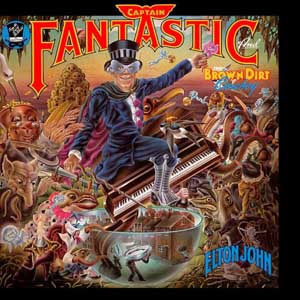
Captain Fantastic and the Brown Dirt Cowboy at 50
• James Campion
Elton & Bernie’s Masterpiece is My All-Time Favorite Album
From the end of the world to your town…
The twenty-third day of May will mark the fiftieth anniversary of Captain Fantastic and the Brown Dirt Cowboy, the ninth studio album by Elton John. Its significance, beyond being his most popular LP at the time and the first to reach No. 1 on the Billboard Album Charts before its release, is that it remains my favorite album of all time. Despite so many groundbreaking records that turned me upside down, no collection of songs better defines the awakening that occurs in a music-listening evolution, and none has had as lasting an impact on me as a writer. In fact, the album’s lyrics by John’s longtime songwriting partner, the great Bernie Taupin, was paramount in my developing a sense of storytelling, the framing of nostalgia as memoir, and the craft of pinpointing the moments that blossom artists into their art.
Will the things we wrote today
Sound as good tomorrow
“Writing”
Beyond all that, the tracks on Captain Fantastic are some of the most well-crafted pop songs of any era, this includes the Tin Pan Alley, Brill Building and Dylan/Beatles compositional excellence in twentieth century music making. This seemed a plausible outcome in 1975, since the Taupin/John duo had established themselves as the most prolific songwriters of the period. Elton’s incredible album/singles run dominated the charts and made the flamboyant pianist the most famous rock star on the planet. Despite its paucity of hits, its producer, the inimitable Gus Dudgeon, the man who guided the early Elton records, called Captain Fantastic the songwriting team’s best work, gushing, “There's not one song on it that falls below incredible.”
It is hard to explain just how huge Elton John was in the mid-1970s. I was what they now call a tween then. When Elton made a cameo as the Pinball Wizard (absurdly giant boots and all) in Ken Russell’s film version of The Who’s Tommy, the lines were around the block, and everyone was there to see Elton. When he appeared on screen the audience leaped up and cheered. Having yet to attend a proper rock concert, it was my first experience being absorbed into the boisterous collective, my tribe, a generation reared on the fumes of the great 1960s cultural movement and weaned on genre-schlock, blockbuster films, gory exploitation and Disney bullshit. That day we or I was liberated.
I adored Elton before Tommy or Captain Fantastic. He was on the radio all the time. The run of hits is unfathomable: “Your Song,” “Rocket Man,” “Honky Cat,” “Daniel,” “Crocodile Rock,” “Bennie and the Jets,” “Goodbye Yellow Brick Road,” “Saturday Night’s Alright for Fighting,” “Don’t Let the Sun Go Down on Me,” “The Bitch is Back,” “Philadelphia Freedom.” I got many of those 45s and had the Greatest Hits record, but Captain Fantastic is the first album I remember buying with my money. I have a faint memory of taking a couple of bucks from my mom’s purse to help me get to the seven dollars it took to bring it home, but I am sure that is pure fantasy, because the chances my mother would have ever been more than a foot away from her pocketbook is laughable. But I do recall her sitting with me upon one of a dozen initial listens pouring over the lyric sheet to figure the story Bernie and Elton were telling. And what a story.
Captain Fantastic is filled with the haughty confessions of youth hijacked by a dream to make song. Because song transforms a view of the world, a world you did not make and are otherwise forced to accept. Music breaks barriers and song explains where one goes when they fall. And for Bernie and Elton their journey of spiritual oneness, which is told succinctly in the title track, ignores the signs of failure and envisions the ride as triumph. Two friends against the relentless gale winds, finding a voice and crafting the tunes to bring it forth. Song as currency. Song as a ticket to new horizons – very much a vision quest. What matters to the working musician is to tap the soul for tunes we sing that make all the rest worth it: The forward motion of the next one you must play.
Sentimental tear inducing with a happy end
“Bitter Fingers”
The duo’s method went like this: Bernie sent lyrics to Elton, and he went off to compose the songs. Never in the same room. No discussion. No compromise. Bernie said his piece. Elton played the piece. Unlike previous records, though, Captain Fantastic was created in chronological order. There is a palpable building to a crescendo. Even as a kid I could feel it. The two young men (Elton was 28 and Bernie would turn 25 the day before the album’s release) recall their recent past, how they survived turmoil and maturation and reached the impossible heights of fame and fortune. On the album that precedes Captain Fantastic, Goodbye Yellow Brick Road, the songwriters came to grips with the glitz and glamour their music making had wrought – naïve, snot-nosed English kids seduced in Hollywoodland. It was not a pretty end game. In Captain Fantastic, they discover who the hell they were and how they could have possibly gotten here.
Hand in hand went music and the rhyme
The Captain and the Kid stepping in the ring
From here on sonny sonny sonny, it's a long and lonely climb
“Captain Fantastic and the Brown Dirt Cowboy”
The characters in Captain Fantastic (which is less concept than song-cycle) are spectacularly entrenched in English letters, a Dickensian trip through time. Each track unfolds as if a libretto (which MCA records included in the package along with a booklet called Scraps that housed all the crap young kids hang onto just in case, not to mention the mind-bending cover by painter, Alan Aldridge based on Hieronymus Bosch’s hedonistically sublime The Garden of Earthly Delights). Cigar-chomping publishers, music biz villains, apathetic audiences, bar band hacks in a relentless harangue of needing material for gigs and money and station. The foggy streets of London were filled with mysteries buried in the dreamers’ anxieties. Are we songwriters or frauds? Are we on an accent to something big or crashing into a ditch of shame and poverty and confusion. Good stuff for songs. And the songs deliver.
While the Diamond Jims and the Kings Road pimps
Breathe heavy in their brand-new clothes
I'm on the bottom line
“(Gotta Get a) Meal Ticket”
And then there is “Someone Saved My Life Tonight,” the best song Bernie and Elton have ever written. Maybe one of the best songs anyone has written. It is dark, penetrating, uplifting, redemptive. It is at the very least the most distinctively lyrical blow-by-blow of self-reflection, identity and suicidal thoughts ever put to melody. With all that depth it was still a massive No. 1 hit, dominating the last days of seventh grade and hovering above my steamy summer. It was Bernie spinning Elton’s life-altering dilemma unto death – the spiritual, creative, emotional demise of a closeted and frightened gay man trapped in a lie of a damaged relationship to a woman that is to end in marriage. A friend and former employer, Long John Baldry talks Elton down from the hanging noose that threatens the dream, as John did indeed try to kill himself. Thank God my music’s still alive. The accompaniment is epic. The band exalting its theme.
This is the final album for the great Elton John band, who were there from the beginning – first as a trio, Dee Murray on bass and Nigel Olsson on drums, joined later by guitarist Davey Johnstone and percussionist, Ray Cooper. The performances here are staggeringly emotive bringing the song-stories alive, providing dynamic density and mining the pathos brimming beneath the notes. And Elton never sounded better. Coming after his pseudo-American accented countrified phrasing that gave way to his superstar flights of glam-speak and just before the cocaine and alcohol abuse and resultant vocal nodules from nearly two decades of bellowing over packed audiences, he is in his fleeting prime.
Fittingly, the album ends with a colossal suite, beginning with the gorgeous “We All Fall in Love Sometimes” that moves effortlessly into “Curtains,” two songs of brotherly love, survivors of the bad, the good and the musical. Elton’s tender piano, Murray’s sinuous bass line. Johnstone’s sweetly rendered guitar lines driven with controlled passion by Olsson’s drums that explode into emboldened timpani of fury by the end. Its tributary “Hey Jude” coda of ooohs and glorious descants eternally fade into an unknown future.
Captain Fantastic and the Brown Dirty Cowboy does something for me that I hope your favorite albums and songs do for you – continue to thrill you while transporting you back to a time when everything was everything. That was, for me, what being a kid meant, the totality of growth, trepidation, freedom – a final halt of the perpetual stride toward adulthood and then the end. Salinger’s “catcher” holding back the inevitable to remind you who you were so you can figure the whole “what you’ve become” paradigm. The fact that Bernie and Elton were figuring that out as well put me squarely in their crosshairs.
They got me.
Forever.
And just like us
You must have had
A once upon a time
“Curtains”
In that way, the magic of Captain Fantastic is that it is a time piece and timeless.
© James Campion 5.22.25
Online version with additional media:
https://www.theaquarian.com/2025/05/21/profonde-musique-captain-fantastic-the-brown-dirt-cowboy-at-50/
Follow at https://www.facebook.com/jamesbartolommeocampion/ X (@FearNoArt) and Instagram (@jamescampion).
James Campion is the the author of “Deep Tank Jersey”, “Fear No Art”, “Trailing Jesus”, "Midnight For Cinderella" and “Y”. +, “Shout It Out Loud – The Story of KISS’s Destroyer and the Making of an American Icon” + “Accidently Like a Martyr – The Tortured Art of Warren Zevon” and “Take a Sad Song…The Emotional Currency of “Hey Jude" and coming in 2025, “Revolution – Prince, the Band, the Era.”
More reviews
Stephen Kellogg's Complicated Bonds of Friendship
James Campion 5.8.25
Stephen Kellogg is always writing songs. Even when he is without a guitar or a whistle on his lips, he is composing.
The Day Robert Johnson Died
James Campion
American Lore & the Curse of Virtuosity
Why Warren Zevon belongs in the R&R HOF
James Campion 3.13.25
Warren Zevon was one cool guy, whos

no liability accepted by hackwriters.com or affiliates.