
Index • |
Welcome • |
About
Us • |
21st Century • The Future |
World
Travel • Destinations |
Reviews • Books & Film |
Dreamscapes • Original Fiction |
Opinion
& Lifestyle • Politics & Living |
Film
Space • Movies in depth |
Kid's
Books • Reviews & stories |
The International Writers Magazine: Dogs, Ice, Skiing - ArchivesWhile other people are looking to relax, chill out and lie prostrate upon a sun lounger baking their white skin in the sun I prefer to be slogging my guts out doing some form of self propelled transport across a vast empty space. In the past I have rowed across oceans but on this occasion I decided to ski across the Greenland ice sheet.
Mad Dogs and English Skiers
• Jo Davies
For most people a summer holiday involves pouring over internet deals looking for the best special offer they can find involving sun, sand and possibly Sangria. For me it entails looking for the craziest, most adventurous and usually active trip I can find.
But it wasn’t quite as simple as that, actually I was invited to join an expedition by a friend of mine who needed some extra bodies to deliver some dogs home. Sounds bizarre I know but that was the jist of it. Knowing I had yearnings to explore the polar wastelands, Steve contacted me and asked if I’d be interested in skiing and dogsledding across Greenland. At the time I was contemplating entering the Polar Race – a crazy race to ski to the North Pole and so I jumped at the chance, knowing that this would be the perfect opportunity for a taste of polar expeditioning. At a tiny fraction of the cost of going to the North Pole, the trip to Greenland would give me a chance to test out my capacity for cold weather and endurance.
With a little over 10 months until the trip I began preparing by starting a fitness-training regime. We would be making the 530 km crossing from West to East on touring ski’s aided by dogs – they would be carrying all our kit leaving us free to ski unburdened. Some might accuse us of cheating but skiing 20-30 km per day is hard enough without the weight of tents, food and fuel dragging along behind. My training involved a good deal of running and gym work – the cross trainer particularly. I then decided that I should try and get some experience of cross-country skiing as I had only ever done downhill before and am a snow boarder anyway. This proved to be an issue due to the lack of snow and cross-country ski trails in Great Britain. Then a friend suggested I try roller skiing – I nearly fell off my chair laughing – I had never heard of such a thing.
Apparently you can ski around on a pair of ski’s on wheels! After picking myself up off the floor I went off to look it up online and discovered a whole society of people involved in this unlikely sport. And they even did lessons in it. In Hyde Park. In front of the whole world.
So one Saturday morning I showed up in Hyde Park, ready to be ridiculed, only to find myself gliding along (that came much later after many wobbly attempts to stand upright) with some other crazy loons and actually learning the techniques of cross-country skiing on a pair of planks attached to wheels. Poling myself along as if surrounded by deep thick snow! Then February came about and the organisers packed us off to Norway to learn the real thing.
Finally, the time came after much buying of kit, running and roller skiing up and down the Thames towpath, much to the amusement of local dog walkers, for us to embark upon our journey of a lifetime.
We were due to set off at the beginning of June 2009 and arrived in Kangerlussuaq on the West Coast of Greenland. Kangerlussuaq is a small town perched on the edge of Greenland’s longest fjord – it wends its way 190 km to the sea where it spills into the Davis Strait. In May the town was a dustbowl in the middle of a desert – the snow had melted but it wasn’t quite warm enough for the grass and flowers to grow for their brief spring and summer. The main focal point of the town is the airport, which serves as a hub for flights coming in from international destinations and a jumping off point for tourists going to the icecap. In a former life Kangerlussuaq had been a US Air Force base and ghosts of the American life still remained; the old golf course that the bored pilots had created was on the edge of town, ramshackle old clubhouse included.
There were four of us in the team, myself, another girl called Hannah and two guys; Richard and Jon. Richard was an experienced Polar Traveller having been down in the Antarctic in the 1960’s with teams of dogs before they were banned from the ice. We spent 4 days here in this dusty and desolate place waiting for word to fly out to the icecap. We amused ourselves by hiring bikes and taking walks up some of the hills admiring the stunning geology and views across towards the Russell Glacier. We discovered the outrageous but understandable cost of food in a country where nothing grows and so all food is imported by plane from Denmark and experienced rather delicious musk ox pizza from the town’s one and only restaurant – a takeaway pizza joint.
Just when we were beginning to think we would be stuck in world’s most boring town forever, we got the call to go. With only 3 hours notice we hurriedly finished our packing. Having packed and repacked and panicked about what we should be taking we were finally on our way. Excited and nervous, the four of us made our way to the airport where we were to board our chartered Twin Otter plane and head for the great vast white polar plateau that is the Greenland ice sheet. We were to be dropped at Dog Camp, a position somewhere on the ice, only known by GPS co-ordinates as there are no landmarks or anything at all to distinguish it from any other part of the ice. Carl, our expedition leader would be waiting there with the team he had brought across from the East Coast and the dogs. We were the relief team, taking over from the others to return the dogs to their home on the other side. The Greenlanders keep the East coast dogs separate from the West coast ones – something to do with breeding and disease control I think.
Flying across the ice was an incredible experience – we crossed the massive Russell Glacier, looking down on the ripples and waves that define the glacier from above; whites and blues interspersed with patches of rock.
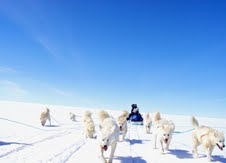
As we stepped off the plane we were greeted by the sound of thirty-six Greenland Huskies all voicing their opinion about their forthcoming meal. It was an incredible sight – most of them had their heads tipped back, their noses in the air and were howling with gusto into the early evening sky. We had arrived at feeding time and the Inuit dog handlers were just preparing the hoosh that they are fed on twice a day. Each of the dogs would be given a scoop of the hoosh dolloped onto the snow in front of them.
The next thing that assaulted our senses was the smell – fresh dog poo! One might imagine that it wouldn’t smell too bad out there in all that fresh air but husky poo has a distinct stink and when there’s thirty six of them all emptying their bowels randomly and then lying in it before it freezes over, it certainly dominates the air.
Having waved off the other team on the departing Twin Otter, we then settled into our tents and had a chat with Carl about the coming days ahead and what we would be faced with in the journey across the ice. With five hundred and thirty km of ice sheet to be tackled, we had limited supplies of both dog and human food and so we would need to travel at least twenty km a day, if not more. With three dog teams and only two Inuit Guides, we would be required to man one of the dog teams and so would be taking it in turns each day to rest from skiing and drive the dog sled. The prospect of a rest day pleased us immensely and we would all look forward to those days when we could sit back and enjoy the ride, allowing sore muscles and blistered feet to recover.
The first few days were tough, settling into the routines of eating, skiing, camping and sleeping but once we had got through those days we began to enjoy the time spent plodding along, taking it in turns to “break trail” as the first person in line to cut through the varying snow conditions. We were blessed with good weather too – the sun shone 24 hours a day and the snow was crisp and fresh so skiing through it was relatively easy and not slushy which would have been a nightmare.
One might imagine that the landscape would be dull and boring – being an uninterrupted expanse of whiteness but far from it, throughout the day the landscape would change according to the light and cloud conditions; on a cloudless day the snow would glitter in the sunshine like sparkly frosting on a cake. The seemingly flat landscape was covered with ridges and bumps known as sastrugi, formed by the wind blowing the snow and resembles a beach at low tide when the sand ripples are revealed. As the sun moves around with the passing hours the light changes and at around one in the morning when it is at it’s lowest the shadows lengthen and colours are soft and golden; this being the closest it gets to setting up here in the land of the mid-night sun. Some days were cloudy and overcast and navigating became nigh on impossible; the sky merging with the snow and no landmarks to guide us.
A piece about this trip wouldn’t be complete without a word about the dogs. The dogs were amazing. I did not expect them to be such friendly and personable animals. These wolf-like creatures are born in and bred for some of the harshest conditions known to man and beast, they are permanently kept outside in the snow and are fed on raw seal meat and anything they can hunt in the summer. They are used for dragging heavy sleds all over Greenland on seal hunting expeditions with their masters. Their purpose in life is to work. One would not expect them to allow people to touch them and approach them but these dogs were more friendly and cuddly than many domestic pet dogs I have come across in Britain. We were forbidden to feed them anything – no scraps or treats because it is important that only their Inuit master feeds them and so we could only work with them and pet them.
There were times when we were tired and grumpy and the cold would be biting through our many layers making us miserable and tetchy. But being part of such a small team and relying on each other for our survival mean we had to overcome those difficulties and have the patience and strength of character to look after each other.
As the trip progressed we grew more and more used to the conditions and had some amazing experiences, co-existing on the ice together in small tents and spending each day skiing together was a great eye opener for many of us. We learnt a great deal about ourselves and how we cope under pressure in an extreme environment.
We arrived after 20 days on the East Coast, greeted warmly by our Inuit guides’ families who had sorely missed them after nearly two months away from home. The last part of the journey had been particularly hair raising as we had to cross a large glacier which meant we were at risk from falling down gaping crevasses and into patches of melted snow and ice known as overwater.
The whole expedition was a fantastic eye-opening experience, a once in a life time for some people, but for me just a taste of what’s to come as I sit in my kitchen in Cornwall planning the next step which will hopefully take me to the South Pole.
A full blog of the expedition can be seen on our website:
www.transgreenlanddogexpedition09.co.uk
© Jo Davies June 2010
jodavies33 at yahoo.co.uk
More life choices