

Welcome • |
About
Us • |
New Mystery fiction set in Spain |

27 Years Online
••• The International Writers Magazine - Finding Totoro
Mitika
• kab
I think I could have found my way to Mitaka by myself. I had, after all, found my way to the Sagano forest in Kyoto by myself.
the majestic camphor shadows
the stone fox
watching moths in moonlightBut I had my hosts, Satoshi and his family, escorting me. In many ways it made the trip more enjoyable. In other ways it made the trip more painful. There were many things I expected to find in Mitaka. There were many things I found there. In a sense my trip to Mitaka was a pilgrimage. I wasn’t exactly sure why I was going there, but going there was something I had to do.
In Kyoto there were no signs saying, “foreigners go this way to Sagano Forest!” I had to take a train from Kyoto station to Arashiyama. On the train there were two young girls standing next to me. One had her phone open, and the two were checking for messages or perhaps just talking about the phone. I noticed the wallpaper for her phone and, being a rude American, pointed to her phone and said “Totoro.” The two girls looked at me, I smiled and then the three of us started laughing. They would then say “Totoro” and I would say “Totoro” and we would laugh again. At Arashiyama I had to find my way from the train station to the Sagano forest. I was the only American in the area and there were very few signs in English. I did have a map from a guidebook. And at the train station I found another map of the area, a little more detailed. But I had to figure things out from the pictures. After wandering off in the wrong direction a couple of times, I finally figured things out and found myself entering the beautiful forest of 70-foot-high bamboo.
The day we went to Mitaka, Satoshi and his family met me at Tokyo station. We spent the morning wandering around central Tokyo looking at sights and reacquainting ourselves with each other. He worked in the Tokyo office of my firm. My secretary had arranged for us to meet, even though I was there on vacation. But all the while we were wandering around Tokyo, in the back of my mind was always the anticipation of Mitaka. My imagination had conjured up all sorts of images of the place, and I was excited about finally getting to see it. We visited a shrine, an apparently required activity on any outing. We then had lunch. Satoshi insisted on taking us to a famous Katsu bar that was very difficult to find. Everything in Tokyo can be difficult to find. Addresses have no meaning, at least if you want to use them to find places. And a true Tokyoite, just like a true New Yorker, will not use a map. But we eventually found the place, tucked away within a series of small side streets not far from Ueno Park. We then took the subway to Shinjuku Station, got on the JR Line train, and traveled north to Mitaka.
When arriving in Mitaka, the train tracks are raised up above street level. Walking down to street level, there is the Museum bus waiting to take visitors. There is no doubt it is the right bus. It has clearly written on the side, in English, “Ghibli Museum” and is painted yellow and covered in white figures of bugs, frogs, and other sprite-like characters from Hayao Miyazaki’s films. We had plenty of extra time and decided to walk to the Museum, not far from the train station. To get to the museum we traveled along the Tamagawa Josui canal that goes straight through the village. According to Satoshi, the canal was built as a drinking water source 300 years ago and has always been an important source of water for the city. Satoshi was the classic gentleman host, researching each area we visited in great detail. He seemed to love telling me about seemingly obscure historical facts of whatever place we visited. Earlier in the day he gave me a long description of the history of the small temple we visited, the Sengakuji Temple, where 47 ronin had been buried.
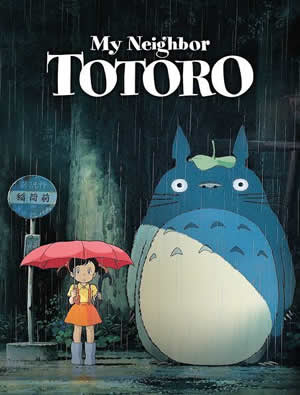
You might rightly wonder why a 50-year-old investment analyst from New York is coming to visit the Ghibli Museum in Mitaka, Japan. Certainly, there are many wonderful sights to be seen in this beautiful country. But the truth is I love Miyazaki’s films. I believe “My Neighbor Totoro” is one of the best films I have ever seen. His films have beautifully rendered settings, deep multidimensional characters, and stories that touch your heart. The beginning of “My Neighbor Totoro” is a good example. A nerdy-looking father is driving a strange-looking vehicle loaded up with furniture and other family belongings. In the vehicle are his two daughters, who are the main characters of the story. They are clearly in the process of moving. They are traveling through the countryside that is deeply green and very beautiful. Huge billowing clouds float through the sky. It is a warm summer afternoon. They occasionally pass other vehicles or people working in the fields, but otherwise are alone, although after a short time you see there is another man in the vehicle, helping them in their move. They all seem happy and gay and full of excitement for what the future may hold. This is like a place from my dreams. When I die this is the kind of place my soul will be brought to. Miyazaki has painted a serene, blissful environment where people are kind to each other and the world moves in a slow, timeless pace.
The museum is tucked away in a large, wooded park. People were milling about, as they do anywhere in the world there are parks, out for restful walks. Tickets for entry to the museum are timed, so we must arrive at the right time to be allowed in. But there is no hurry. It is easy to find. There are little signs with animal characters on them that give the distance to the Museum. We walk at a gentle pace enjoying the canal. A couple of colorful ducks are paddling their way back to the train station. Mitaka seemed like a nice quiet place to live. But I could well imagine the bustle and rush of early morning when people head to the train station for their commute into Tokyo, and Japanese children, in their school uniforms, walking in groups to school.
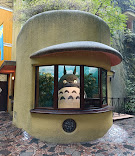
We approached the museum from what appeared to be the maintenance entrance. Two large barn-like doors were chain locked. We then passed what looked like an older ticket entrance. Satoshi’s son and daughter became excited because there in the windows stood a huge Totoro, at least 7 feet tall, looking out from inside the ticket booth. Its large eyes stared wonderingly out at the passing crowds. Its mouth was puckered, frozen in perpetual awe. People stopped and stood in front of the window to get their picture taken. I took a picture of Satoshi and his family. The Totoro looked just as excited as the kids, its’ ears erect with the same kind of expression as a startled rabbit. I never really had the chance to study Japanese folklore, but I have read a few stories translated into English. I have never been able to learn whether this Totoro creature is part of some old folk tradition or is some invention of Miyazaki’s. Nevertheless, I like to think it all came from his imagination. I wonder what a moment in his mind would be like. Would it be like soaring over the hills and through the clouds of some rural countryside, as he created in “Kiki’s Delivery Service” or over some fantastic world of strange plants and trees, as he created in “Nausicaa of the Valley of the Wind”? What ideas are in his head that have yet to escape, to find themselves in our collective imagination? What ideas are trapped inside, kept as his own, never shared, never to be more than his own momentary fantasies? I am but a simple-minded person, without the immense imaginative capability of Hayao Miyazaki. My mind is cluttered with stock codes and company profiles. Seeing the creations of this man is akin to standing at the edge of the Grand Canyon or standing over Niagara Falls. I cannot comprehend how he could have thought of and created these wonderful things.
Entering the museum made me think of what it might be like to enter Alice’s Wonderland. You first enter the small room where they take your ticket, replacing it with a very special ticket, a souvenir set of frames from a movie reel. This ticket also gives you entrance to the museum movie theatre, to see a short film. You then descend down a narrow corridor to the main hall of the museum. Once inside you are in a different world, a world with fantastic creatures, magical devices, and, for me a place where my inner child reveled in fantasy while my conscious mind anguished in the melancholy of bittersweet memories.
The outside architecture of the museum is very organic, as if it was something that grew out of the ground. The corners of the walls are all beveled and rounded. The walls themselves have a rough stucco look; colored in white, pale yellow and pale green sections. All the windows are dark trimmed wood with many panels containing stained glass scenes from various Ghibli films. The tops of all the buildings are well maintained garden spaces, the largest on top of the main building. Walking through these gardens brought me back to Kyoto and the great forest of bamboo. When I was in the Sagano forest, I wandered down one narrow path to find a little Inari shrine. There was the standard entrance, or Tori gate, with little red fences around the shrine buildings. It was surprisingly crowded, given I saw few people outside the shrine. Nobody seemed to notice me, although I know from my wanderings around Japan that everyone was well aware of me. I wandered through a path to some well tended gardens, to another smaller shrine, filled with little porcelain foxes. As odd as it all seemed to me, I found it all rather beautiful. It made me think back to a trip Miles and I had taken in 1989 to upstate New York. We were driving late along some mountain roads when a fox jumped out from the woods. Miles was driving and he didn’t react fast enough to avoid the poor fox. It took me all night to calm him down. He didn’t take death very well. It tore him up to think he had killed something.
Inside the Museum there is a wonderful zoetrope of characters from Totoro. It is an incredible work of art and technology. It spins around and the little figures suddenly come to life. Little Totoros waddle along, Satsuki, one of the sisters from the film, and another Totoro are swinging a jump rope, and the catbus is running through the air. After a while it comes to a stop and you can see that it is just a bunch of figures, none of which are really as alive as they looked a moment before.
The Museum is much more than just a collection of artifacts from Ghibli studios. It is something of a playground. In the walls there are little portals that just kids can fit in, that can take them into another room or private space. Adults look in and can wonder about trying to fit past, and some can, but these places are meant only for children. There is a huge stuffed catbus in one area, guarded by Museum staff, where only children are allowed, with shoes off, of course. For me, watching the children is pure delight. The Japanese children are always so quiet and polite, but here they let loose and I get to see them as children are everywhere, playful and innocent, cherubs of giggles and imagination in motion.
“My Neighbor Totoro” is remarkable in one very simple regard. There are no bad guys. There is no violence. But there is fear. There is the ignorance of innocence. There is love. The story takes you into the world of the little girl, Mei, who finds her way into a magical place of spirit-like creatures, invisible to adults, and even to most other children. The Totoro, of which there are different types and sizes, are a part of the Earth. They seem to be timeless beings. And being connected to the forest and the wind one feels they must be old. Yet they have the innocent nature of children. But, most importantly, they are good, gentle, and caring creatures. None of the people in the story could be called a hero, although Mei’s sister, Satsuki, is heroic in her search for Mei, when Mei gets lost trying to find her way to her mother’s hospital. Satsuki’s heroism was the desperate heroism that came from the fear of losing her sister. I know this feeling too well. I lived through this when Miles became ill. This is the worst kind of fear. It is the hopeless, helpless, inevitability that tears you slowly apart as you watch the person you love slowly weaken and wither away.
For me, visiting the Ghibli Museum was an escape from my escape to Japan. It was a world of pure fantasy, embedded in a world that seems always just slightly out of step from reality. In Tokyo there are doormen with little white gloves who bow to you as you enter and leave. At the Tokyo tower there are beautiful young girls all dressed in cute purple uniforms and hats, who don’t seem to really do anything, but smile, bow, and direct which way you should go, even though there is no doubt to the direction you need to go. In Ueno Park I saw a group of firemen performing practice drills. They all wore neat uniforms with white gloves and most of them had white cloth face masks. They all lined up in perfect lines, following in perfect unison the orders of two older firemen. It all looked so efficient, yet I, with my non-Japanese sensibilities, didn’t feel confident about this group of firemen. It was a big contrast to my everyday experience with the New York City firemen, who always look disheveled and disorganized. Yet they somehow always seemed very competent and instilled a feeling of confidence. People in Tokyo are polite on the trains, even in the morning rush hour when they pack more people into one train car then would fit on two New York A trains from Penn station. Miles would have loved it there. He would have gone and gotten his own pair of little white gloves. He would have hugged the girls in their uniforms and insisted on having his picture taken with them. He would have spent hours watching the fireman and embarrassed me by applauding for them, as if he was at some Broadway show. Miles did not like the real world. He always had his head in some book or was talking about some story he was thinking up or had heard. He didn’t like certain “real” stories. He wouldn’t go see “Rent.” He would complain, “I don’t want to see a show about people dying in New York!” He would rather watch Kiki on the DVD or read old western novels with strong good cowboys rescuing beautiful maidens from ugly bad guys.
The one scene in Totoro that breaks my heart more than any other is when the little girl Mei wanders down into the Totoro’s lair. In the Japanese view, she is entering a temple, and the Totoro is the spirit of that temple. For me it is like leaving the world of the living to enter a world where life is eternal. This is what we think death is like, a transformation from our physical life to an eternal spiritual life. But the Tototo’s lair really is more like a temple. And, in a sense, a temple is a place that lies between the world of the living and the world of the dead. It is where one goes to pay respects to those who have gone on to a spiritual existence. It is where one goes to ask the local spiritual guardians to watch over you, to assist in warding off other spirits who may want to harm you and to look after those that have entered the spiritual world, which may not be as safe a place as we think. When Mei finds the large Totoro sleeping blissfully in the small glade she climbs boldly onto its belly and tickles its nose. Then, after a little while, she falls asleep on this soft furry creature’s belly.
Miles loved this scene. He would sit on the couch, curled up with his chin resting on his knees, and watch the scene over and over. I think how comfortable it must be to curl up on the soft furry belly and take a long restful nap. I think how wonderful it would be to lie in the world between the living and the dead, to converse with each. I think how painful life is now that I am alone, and how I can’t talk to the one person I could always talk to. To the one person who understood me and loved me, nevertheless. I think how much I long to be in the world of Totoro, where people are kind to each other, work together to sort out problems, and where people who are sick get better. When I stood against the wall watching the Japanese kids playing on the huge stuffed catbus I almost thought it was possible. But I reminded myself, I was in Japan. That was not my real world. It was the place where I imagined that I could escape my pain. But it was the place where I found the spirit of Miles and the beauty of his heart, like the heart of Miyazaki, like the spirit of the children playing on the big stuffed catbus.kab (First published here in 2008)
How does it feel?
kab 9.01.25
So, pretty girl, what does making America great again mean?

no liability accepted by hackwriters.com or affiliates.