
|
Index
•
|
|
Welcome
•
|
|
21st Century•
The Future |
|
World
Travel•
Destinations |
|
Reviews•
Books & Film |
|
Dreamscapes•
Original Fiction |
|
Opinion
& Lifestyle •
Politics & Living |
|
Film
Space •
Movies in depth |
|
Kid's
Books •
Reviews & stories |
|
|
|
|
The International Writers Magazine - Our Tenth Year: Laos
Best Laid Plans in Laos
• Christina Hoag
When I travel, I make a point of doing what the locals do as much as possible, you know, be a traveler not a tourist. But sometimes you’re better off just being a tourist. This proved to be one of those times. I had spent a couple days in Luang Prabang, a picturesque old French colonial town in northern Laos that’s the country’s main visitor draw.
I strolled around the 19th-century mansions, with their wrought iron balconies and louvred shutters, which now housed enchanting guest houses and artsy boutiques. I visited the temples with resplendent mosaics and chatted with student monks in broken English. I toured the Royal Palace Museum, which stands much as it did in 1975, when the Communists took over and the royals disappeared without a trace. I was dazzled by the throne room, with its walls covered with mosaics of tiny brilliantly-colored mirrors and I rolled my eyes at the chintzy plastic model of a space capsule gifted by Richard Nixon. I plunged in the icy-turquoise waterfall pools outside town.
In the evenings, I shopped at the handcraft market in the street and took in a traditional dance performance at the Royal Theatre.
Overdosing on quaintness, I was eager to move on. I decided to splurge and laid out fifty bucks to fly to the capital of Vientiane. I figured I’d save myself a ten-hour road trip and gain some time in my three-week backpacking trip around Southeast Asia.
The small airport on the outskirts of town seemed unusually quiet, but everything was laidback in Laos after hustling, bustling Thailand. I was met with a blank stare at the check-in counter but that’s how everyone seemed here. This socialist regime really casts a pall over the people, I thought.
Blankness changed to frowns to a whispered consultation with a guy in an office to a phone call. The manager came out. "Madam, no plane today. Day after tomorrow."
The travel agent in town had booked me on a nonexistent flight. The agent arrived somewhat embarrassed. No, I did not want to stay another two days in Luang. I’d had my fill of colonial cuteness. He said he could book me on one of the tourist minibuses that go to Vientiane. Aha! I thought. He’s just trying to sell me his expensive tourist service.
"Isn’t there a regular bus?" I asked.
He looked uncomfortable. "Well, yes," he said.
"So, I’ll take the bus."
He refunded my money, minus his booking fee, and took me to the bus station.
Bus stations are never the most savory of stops, even in the best of places. This one resembled a grimy gas station. And I was the only foreigner there. I should have paid attention to that.
A man who spoke a little English approached. He helped me with my ticket and pointed out the right bus. He was the only person who spoke to me, or even smiled at me, for the next ten hours.
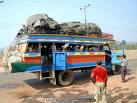
The decrepit, diesel-fume-spewing bus pulled up and we boarded. Thinking I was being oh-so clever, I sat in the rear so I could stretch out. I noticed the locals were arguing and crowding into the seats in the front. I should have paid attention to that, too.
I soon found out why. Shock absorbers were apparently luxury accessories here. As the bus gathered speed down the road, I was bounced non-stop up and down, my bum actually rising inches off the seat. I couldn’t stay still. There was no way I was going to be able to take ten hours of this. I moved up as far as I could, but it was only a marginal improvement.
I then noticed the man in front of me holding up his camera cell phone. He was using it to spy on me, I was that much of an anomaly. I tried to bob and weave out of camera range, but he just followed me with his lens until I finally positioned myself directly behind him and he gave up.
It was a bone-rattling, mind-numbing ride - about five hours of cliff-hugging hairpin turns up and down mountains. All I could do was hang on, forget reading or writing. The trip’s saving grace was the panorama – enormous shark-tooth-jagged peaks of rocks soaring into the sky, terraces of lush green rice paddies and locals, conical hats pulled low over their heads, clopping along in oxen-drawn carts.
We stopped a couple times and made use of the toilets – holes in the ground. I was starving but I couldn’t make out what the food was so I chowed down my supply of granola bars and got hungrier. I did, however, recognize big black spiders at one stop. An old woman was pulling them out of a sack by the fistful and dropping them into a vat. With a slotted spoon, she fished them out, dripping in thick orange oil, and stuck them in my face. I thought about trying one – I really should do what the locals do - but it was mercifully a brief thought. I shook my head.
It was night when we finally arrived in the gravel strewn lot that served as Vientiane’s bus terminal. I was besieged by taxi drivers and chose one. I gave him the name of a hotel from Lonely Planet and he nodded. He then took me to a completely different, more expensive place, where he obviously got a cut of my room rate. He also charged me more than the cost of the room for the five-minute ride in his three-wheeled tuk-tuk. I started to protest, but I gave up midsentence. It seemed a fitting end to the day.
The next morning, my battered haunches recovered somewhat from the bus trip from hell, I strolled around Vientiane. It was a shabby, rundown city. No danger of traffic jams here – there were hardly any cars. Ditto for shops. Businesses seemed to exist solely in the district that catered to foreigners, the only ones with money to buy stuff, I supposed.
The French are long gone from Indochina – they pulled out in the ‘50s – but some architectural vestiges attest to their former influence, peeling signs like "Ecole Primaire" on government buildings and the colonial mansions along the riverfront in varying stages of dereliction. The best tended mansion turned out to be, unsurprisingly, the Presidential Palace.
Behind the palace I checked out two places of interest. Haw Pha Kaew housed a collection of Lao art and antiquities, including many ancient Buddhas. Wat Sisaket, a temple dating from 1818, sat on the same block. The cloister’s interior walls were pocked with 2,000 small niches, each containing a tiny Buddha. Lining the cloisters sat another 300 bigger Buddhas.
Behind the palace I checked out two places of interest. Haw Pha Kaew housed a collection of Lao art and antiquities, including many ancient Buddhas. Wat Sisaket, a temple dating from 1818, sat on the same block. The cloister’s interior walls were pocked with 2,000 small niches, each containing a tiny Buddha. Lining the cloisters sat another 300 bigger Buddhas.
I ventured into the morning market, Talat Sao, the city’s commercial heart, and trudged up to the Patuxai, a sort of Asian-style Arc de Triomphe at the end of a wide boulevard dotted with Victorian-style lamps. Further up the boulevard lay Laos’ national landmark, That Luang, a golden temple with a huge spire.
Dusk descended. I sat with the English-language daily newspaper and French-language weekly - both published by the Ministry of Information - at a café with some other foreign patrons.
Watching the muddy Mekong wash downstream, I sipped rich coffee – some of the best I’ve ever tasted - and tore into a baguette stuffed with a Spam-like "pate," which seemed to be the equivalent of the country’s fast-food.
It’s not so bad being a tourist, I reflected. Next time, take the minibus.
© Christina Hoag June 18th 2009
choag24 at gmail.com
More life moments in travel
Home© Hackwriters 1999-2009
all rights reserved - all comments are the writers' own responsibility - no liability accepted by hackwriters.com or affiliates.