

Welcome • |
About
Us • |

26 Years Online
••• The International Writers Magazine - Tribute
SLY STONE – 1943 - 2025
• James Campion
Stone was a hustler and a visionary
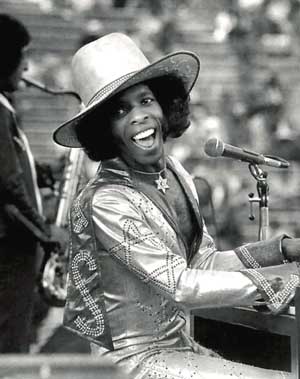
A musical prodigy at age seven from the Bay Area city of Vallejo in Northern California by way of Texas, Sly Stone lived a life that exemplified America’s sonic melting pot of gospel, blues, doo-wop, soul, rock, funk and pop. A verifiable sound sponge and certified music geek, he earned a buck in every corner of the music business, tipping its balances to his own vision. He was a radically influential DJ, diverse and experimental record producer, and eventual bandleader and songwriter, who would sift the cultural 1960s trends, fads and moods through a multi-colored and mixed-gendered prism. Sly and the Family Stone exploded the notions of pop music, as Stone chose to view its arc through its most volatile period as pliable – everything was laid on the table; sex, politics, race, war, and poverty with a voice and sound that spoke truth to the vox populi, reinventing genres and laying the groundwork for musicians and bands that followed his lead into the most dynamic music created in the latter half of the twentieth century.
Sly Stone was also a damaged and complicated spirit, an erratic and untrustworthy presence that threatened his brilliance. Fighting paranoic demons and barely surviving spectacular bouts of drug abuse, his obsessions, both creatively and personally, consumed him. It cost him his reputation, his band, and his family, but it could not erase his immense legacy of musical enlightenment, which infiltrated the zeitgeist in a time when a generation was challenging societal and political norms enhanced by the limitless promise of music. It is in his music and his band’s incredible ability to destroy a stage and fell audiences that made Sly Stone perhaps our most cherished resource of inclusive discovery.
First and foremost, Stone was a hustler and a visionary. Those traits went hand in hand, as from an early age he comprehended the one thing all inventors and explorers must – where his instincts led, he should quickly follow. He knew as a boy that his musical connection to his younger siblings, Freddie and Rose, provided a foundation for his ambitions. Both would help to make up the “family” in Sly and the Family Stone, giving him a security blanket to both embrace compromise as creative fuel and ignore it as a useless parameter. Their gospel origins lit a fire inside Stone he could not extinguish without seeing how high those flames would go. His nucleus was his comfort on the edges. He had a way of seeing gospel as not a stringent set of rules, whether religious or musical, but an outlier, a building block to that of the precursors, Ray Charles and Aretha Franklin, who took the soul and phrasing of this most African American inventions and unfurled it to a secular world.
In high school, Stone discovered the danger and beauty of mixed-race presentation in a doo-wop group called the Viscaynes, featuring predominantly White members with the Black Stone and a Filipino, Frank Arellano. This was 1961, and even in ultra-hip, Beat-centric San Francisco, it bordered on cultural sedition. By fusing music and image to subvert racial animus, Stone had his template for a career that would go beyond mixed-race but include women as major forces in a male-dominated, uber-macho rock and pop landscape.
Stone was already an enthused groundbreaker when he became a famous disc jockey on San Francisco’s KSOL in the early to mid-sixties, creating a show that was an aural stew of soul, Motown, British Invasion, novelty and underground records. This musical and cultural mosaic became the city’s proving ground that would not only birth Sly and the Family Stone, but Santana’s Latin rhythms mixed with jazz-rock, the Grateful Dead’s interceding country/bluegrass/blues/rock, the Jefferson Airplane’s acid-rock distortion, the psychedelic prog-rock of Country Joe and the Fish, the swamp-laden grunge of Creedence Clearwater Revival, the metal-antecedent, Moby Grape, the pop sounds of Quicksilver Messenger Service and eventually the hit-machine that was the Steve Miller Band.
Stone began his shows letting everyone know who their Pied Piper was: “Listen, all you cats and kitties sitting out there, whipping up and wailing, and jumping up and down and sucking up all that good juice and talking about who the greatest cat in the world is. Well, I want to put a cat on you that was the coolest, swingingest, grooviest cat that ever stomped this sweet, swinging sphere. And they called this here cat, Sly Stone!”
Self-promotion and an ear for what music was stimulating ears and exploding movements, San Francisco’s Autumn Records brought Stone in to produce among others, The Beau Brummels, The Mojo Men, Bobby Freeman, and future Jefferson Airplane front woman, Grace Slick's first band, The Great Society. Meanwhile, sought-after as a studio cat, he laid down guitar and keyboards for likes of Dionne Warwick, the Righteous Brothers, the Ronettes, Bobby Freeman, George & Teddy, Freddy Cannon, Marvin Gaye, Dick & Dee Dee, Jan & Dean, Gene Chandler.
By the time Stone was ready to front his own band, which became Sly and the Family Stone, he was the fountainhead of cool and hip with a foreshadowing of the future of American music and youth culture that he wrapped up in a sonic and visual extravaganza. Stone’s brother, Freddie on guitar, his sister singer/keyboardist Rose Stone, one of, if not the most outstanding trumpeters in the land, Cynthia Robinson, Caucasian bad-ass drummer, Greg Errico, also White funk-centric, saxophonist Jerry Martini, and bassist and spiritual center, Larry Graham, whose epic bass line for the 1969 smash-hit genre-busting, “Thank You (Falettinme Be Mice Elf Agin)” challenged Motown’s master, James Jameson, the Beatles’ Paul McCartney and the J.B.’s Bootsy Collins for the most mind-bending bottom end put on record.
It was that magical, mystical, and at times horrifying year of 1969, two years into this living, breathing experimental ensemble to rival that of the Mothers of Invention for the era’s most spatially hybrid music-making that Sly and the Family Stone landed its craft home. The album, Stand!, and its magnificent #1 single, “Everyday People” that was both infectious and seditious in making the case for racial harmony, launched the band to dominate the stages at Woodstock (theirs is the best set, barre none, go listen to it – it is beyond comprehension) and the Harlem shows recently featured in Questlove’s brilliant 2021 film, Summer of Soul.
“Hot Fun in the Summertime” reaching #2 that year and “Thank You (Falettinme Be Mice Elf Agin)” also topping Billboard’s Hot 100 in the early months of 1970 put Sly and the Family Stone in the center of the pop culture universe. The band was burning on all cylinders and looked to be unstoppable. Only Sly could sabotage it. (reach for every biopic, rock casualty cliché you wish here). Missing a myriad of gigs due to drug abuse (Stone was notorious for carrying a violin case of heavy drugs – his pop of choice, PCP, one of the most dangerously brain-crushing street hallucinogens available) and general fame-bubble malaise soon infiltrated the band at large. Moving his operation to the Cocaine Capitol of the World, L.A. by the early seventies, after having been harangued by the Bay Area Black Panthers to desegregate the band (something he deflected time and again) and serve as a mouthpiece for the underground movement pushed Stone to record his band’s most politically incendiary album, There’s a Riot Goin’ On.
The 1971 release, arriving six months after Marvin Gaye abandoned the please-everyone-sunny-outlook of Motown to complete his social-mirrored masterpiece, What’s Going On, Stone answered in kind. Along with yet another chart-topping hit, “Family Affair” that cemented Stone’s belief in his familial roots as musical kinship, along with further commentary on the dilution of the civil rights movement into a violent uprising, There’s a Riot Goin’ On hit #1 on the album charts belying the inner turmoil and disintegration of one of the world’s most important and dynamic units.
Sacking members, and some leaving from fear of burn out or overdose death, Sly and the Family Stone barely survived into the mid-seventies. Stone recorded painfully uneven albums under the band’s name and others as a solo artist, but the drugs and its mental toll had rendered him a shell of a brilliant innovator. The constant search for “something new and exciting” led to darkness and chaos. He became an industry pariah. A sadly pathetic end to one of the most crucial music careers of the rock and soul era, soon to give way to funk and then hip-hop and later major artists like Prince, who based his gender/race inclusive Revolution on Sly’s template. Another multi-instrumentalist, producer and arranger with a kick-ass live template for years decried the use of any drug, including cigarettes, to be anywhere near his band. It is ironic that prescribed pain pills killed him.
Also inspired by the work of Sly Stone was the fusing of rock/soul/funk found in the period’s most prolific Black artists like the Isley Bothers, the Jackson 5’s early 1970s output that surged Michael Jackson’s late seventies into early eighties stylings, and, of course, the godfathers of vaudeville funk, Parliament and its offshoot Funakadelic, both of which owed a debt to Sly and the Family Stone but also moved the needle into the early days of rap and hip-hop to dominate the remainder of the century and well into this one. Much of Stone’s grooves became the foundation of the genre.
Sly Stone was mostly a recluse his final years, battling disease but reuniting with his family and children, as covered with great care by Questlove in his film released earlier this year, Sly Lives: (aka The Burden of Black Genius) delving deeply into Stone’s psychosis and anxieties and the pressures he put on himself as an artist and what his community and generation put on him as their icon.
Beyond the cautionary tales that inevitably come with the breaking of molds that are instrumental for artists of Sly Stone’s ilk, there are the songs and the performances that rise above the gnawing realization that sometimes what gets you on the highwire can trip you to fall into the abyss. Stone was a genius in every sense of the word, because he sought the uncharted territories of music and image and did more to challenge himself than any record company or promoter or critic or fan ever could. He never stopped that search. It was in his blood. It was what made Sly and the Family Stone a juggernaut of unparalleled innovation and joy. Sometimes you get the Jekyll and Hyde to achieve that. And when those two clash in the best and worst of ways you get music that lasts. That’s where Sly Stone went for us, for the music.
We might not have always “let him be himself,” but it didn’t matter. When he was himself, it was damn good.
© James Campion 6.11.25
Follow at https://www.facebook.com/jamesbartolommeocampion/ X (@FearNoArt) and Instagram (@jamescampion).
James Campion is the the author of “Deep Tank Jersey”, “Fear No Art”, “Trailing Jesus”, "Midnight For Cinderella" and “Y”. +, “Shout It Out Loud – The Story of KISS’s Destroyer and the Making of an American Icon” + “Accidently Like a Martyr – The Tortured Art of Warren Zevon” and “Take a Sad Song…The Emotional Currency of “Hey Jude" and coming in *April 2025, “Revolution – Prince, the Band, the Era.”
Top Ten Most Misunderstood Songs Ever
James Campion 4.1.25
I decided to take a crack at what I think are the ten most misunderstood or at least misinterpreted songs ever.
Captain Fantastic and the Brown Dirt Cowboy at 50
James Campion 5.22.25
Elton & Bernie’s Masterpiece is My All-Time Favorite Album
Stephen Kellogg's Complicated Bonds of Friendship
James Campion 5.8.25
Stephen Kellogg is always writing songs. Even when he is without a guitar or a whistle on his lips, he is composing.
Thoughts on Record Store Day
James Campion 4.28.25
Record Store Day has turned into craziness
Online Version with additional media:
https://www.theaquarian.com/2025/06/10/in-memoriam-sly-stone-1943-2025/

no liability accepted by hackwriters.com or affiliates.