|
Index
•
|
|
Welcome • |
|
About Us • |
| Hacktreks Travel • |
| First Chapters • |
| Reviews • |
| Dreamscapes • |
| Lifestyles 1 • |
| Lifestyles 2 • |
The International Writers Magazine: Kulture shall eat itself
The Politics of Boredom
• Phil Mershon
Malcolm MclarenMost people work—not due to some innate passion for their professions—but to make money. In the film American Beauty, Lester Burnham discovers the ideal job in a fast food hamburger restaurant. He is forty-two years old, seeking a job with the least responsibility possible, an entirely appropriate decision given the vicissitudes of corporate work. Now Lester can dedicate the rest of his time to becoming the man he was in high school. He is lucky and free.
Artists are lucky, too. Most of them become workaholics because they don’t have enough time to get everything done. It helps that they possess their own means of production.
When art and entertainment merged through a self-perversion of Pop, the resulting explosion transported Western society forward into the past of a dada future where anything the artist spits is art. This is good news because it provides the workings of a formula for living. In fact, the issue might be better stated, “Anything that happens which is not done in the service of another is art; including spitting.” The satisfaction a person experiences from art-entertainment is predicated on such independence. The false realities of nightclubs, sports, concerts, movies, restaurants and museums exist so that the human psychic pummeling can be stroked and re-energized it allow it to face its own futility. For any who may consider all this to be a fantasy, consider that in 1977, Warner Bros declared entertainment a necessity, right up there with food, shelter and transportation.
What WB did not offer, but easily could have, was the completed formula for contemporary art: life equals work minus utilitarian value (L = W - U). In the final years of the Twentieth Century, the most popular applications of this formula were politics and rock n roll. Some ambitious cretins actually combined the two, hurling up either crippled ideology or lame music. Far more annoying and hence satisfying was the attack on both from the brick-slinging hurricane of the Sex Pistols, the only music group to use politics and rock in an effort to destroy the world.
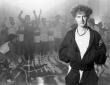
Malcolm McLaren witnessed the Paris riots of 1968 from the vantage of the Croyden art student that he was. During the city-wide revolts, he became obsessed with Guy-Ernst Debord’s Situationists Internationale. The SI’s promoted world revolt against bourgeois happiness, survivalism, the impoverishment of language, all manner of falsity, and particularly against boredom. By the early 1970’s, McLaren found employment as the proprietor of a London fashion boutique, an occupation he reasoned would allow him to synthesize his philosophy with commerce. Catering first to Teddy Boys, then to bikers, and finally to the appeal of simple negation, McLaren found himself attracted to an American band called the New York Dolls. Malcolm let the band know he was their new manager.
The band had already seen its best days. Early 1970’s American pop music mainly walked the overload of the cult of Led Zeppelin or the introspective sniffling dappy doo of California rich kid James Taylor misanthropy. The New York Dolls’ music embraced the razor raw skinning of Detroit’s MC5. Visually influenced by the glitter glam of T. Rex, the aural effect reminded many of the rhythmic blasts of buzz saws boring through active garbage disposals. Yet despite McLaren’s use of onstage communist flags and agitprop sloganeering, he was unable to secure the Dolls a new recording contract. The band let him know he was fired.
Ah, but Malcolm remained the eternal optimist, so he surrounded himself with thugs and petty crooks, namely Steve Jones, Paul Cook, and Glen Matlock, a guitarist, drummer, and bass player, respectively. McLaren kept his nose low in search of a leader for his boys.
One glorious day in April 1975, such a leader presented himself. Into the boutique scuffled a nineteen-year-old named John Lydon. A childhood case of spinal meningitis warped his spine, his chopped red hair shined from the absence of a recent shampooing, and sores spotted his face. Best of all, he wore a Pink Floyd T-shirt with the words I HATE scrawled above the band’s name. It was appropriate that the boys renamed him Johnny Rotten. The Sex Pistols saw rock n roll future and set out to amputate it.
“Ah-right…now…aha ha ha ha ha!” So cawed Johnny Rotten at the opening to “Anarchy in the UK.” While the band turned the air into liquid fire, the singer crowed paradoxes of immediacy. “Don’t know what I want but I know how to get it! I wanna destroy passersby!” With production somewhere between murky and nonexistent, the record revealed four guys ripping through sensory dimensions. The guitar kicked open the windows, the drums shot down the front door, the bass lifted off the roof, and in from the cool suburban skies peered and leered the angry salivating snarl of Rotten, his taunting whine demanding the occupants to resist all other sources of information.
Before the fade, the Sex Pistols shot back with “God Save the Queen,” a non-tribute to Queen Elizabeth’s Silver Jubilee. “She ain’t no human being! She made you a moron!” As critic Dave Marsh pointed out, the only way for Americans to appreciate the political impact of this record is to imagine Reagan’s second Inaugural punctuated by blasts from the most popular song in the country calling the president a Nazi. “No future for you!” Rotten moaned with glee.
“A cheap holiday in other people’s misery!” Rotten warned as “Holiday in the Sun” began as the grandest pop art object in the universe. Just as frightening as its predecessors, it remains the most self-consciously schizophrenic song ever recorded. Here, Rotten goes on vacation to the Berlin Wall, the new Belsen, and finds the divide is a mammoth television screen. He is perplexed. At last he looks, and to his horror he sees that on the other side people are looking back at him, as through a looking glass. His mind scrambles. He will go over the wall, through it, under it. Just as he is about to cross, he begs, “Please don’t be waiting for me.”
Anti-politics and self-destructing rock created the most powerful social revolution since Phil Spector produced Megadeth’s homage to Leopold and Loeb, the ninety-seven minute two disc opus, Cat Chew.
With so much of value being created around the Pistols—most of which was totally unbearable—their impulse was to destroy those who had robbed meaning from the music. So when Mick Jagger, Rod Stewart, Pete Townshend or any other champagne-guzzling hustler released a new album, it was invariably awful because those men had nothing to say with or about passion. Making albums had become their job, one that provided opportunities for a lifestyle alien to most of their fans, a job without art. Listening in 1975 to “Satisfaction,” “Maggie May,” or “My Generation” elicited aches of boredom and irrelevancy. The time had come to strip rock of its pomposities, its overproduction, and its molly-coddled millionaires.
Instead, disco sprang from the innocent fields of Philadelphia International-style purity from groups like The Stylistics, The O’Jays, and (from Chicago) the Chi-Lites. The commodity of music degenerated into fashion fascism, an anesthesia from a boredom that had been endorsed at the corporate levels of entertainment Mecca. Fun took on a utilitarian value all its own, and assumed itself to be an inalienable right, a given attribute of being American.
Art did not keep up with devolution.
© Phil Mershon June 2004
mershonphil@hotmail.com© Hackwriters 2000-2004
all rights reserved