

Welcome • |
About
Us • |

26 Years Online
••• The International Writers Magazine - Profonde Musique
The Connective Pop Music Tissue of Brian Wilson
• James Campion
The Most Significant figure in Pop Music
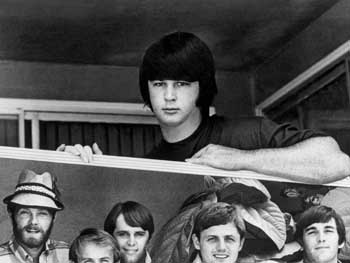
With the recent passing of Brian Wilson at age 82, I return to my lifelong dispute on the erroneously accepted narrative of popular music during the early 60s before the Beatles showed up as a malaise of disposable treacle and teen schmaltz. In his honor, I present three very powerful refutes to this – the singles produced by Phil Spector, the rise of the magnificent Motown, and the Beach Boys. And in all three, Brian Wilson is the indelible connective tissue, and in so being, the singer/songwriter/musician/arranger/producer would become the bridge that leads, especially in America, to the next phase of the most potent generation in rock and roll. This, in turn, triggers everything that follows. And thus, you could make a very cogent argument that Brian Wilson is the most significant figure of his or any era of pop music.
The legend of Brian Wilson is as vast as his miraculous catalog of stunningly beautiful songs and dynamic recordings. His is a story of triumph over tragedy. His is the story of America blossomed from the glory coast of California and its mythical dream of youth heading west to the sea. And as I have written many times over the years, Wilson single-handedly created “sun-drenched hymns to hedonism” in two-minute pop ditties sung by his brothers, a cousin, and a kid from the neighborhood that called themselves the Beach Boys.
Having duly invented the modern myths of California, Brian then did what all true artists and (ahem) geniuses must, he blew all that up and dove headlong into sonic challenges the likes of which the pop world had yet to hear. Those paying attention had to go elsewhere for comparisons. His was the lineage of Bach and Mozart and even Coltrane and Monk, and later Lennon/McCartney, the special ones that imagine the implausible and will it into being.
It begins with Brian as a child prodigy on piano with an unerring ear for pitch and melody, despite being born virtually deaf in one ear. He could play entire pieces – classical or traditional – from start to finish only having heard them once. In his teen years, he took apart the recordings of the Four Freshman, his guiding musical light, and broke down their lush harmonies to rebuild entirely original ones he then taught to his little brothers, Carl and Dennis. Music, as it would be all his life, was his solace, as he by his own admission was crippled by shyness and the fear of a horrible beast of a father, whose broken dreams of stardom was heaped upon his eldest son as a curse. The shouting, belittling, then hiring private detectives to tail him and bug his phone, and the final indignation of selling off the publishing of his son’s music for a pittance furthers the legend of Brian Wilson as a tortured soul – prolific, driven, manic, vulnerable.
Take any act in entertainment history, and chances are it had some measure of gestation. But because Brian was a fully formed musical force at 19, the Beach Boys were discovered and signed and on the radio in mere months with delightfully ambitious five-part harmony-laden songs torn from the echoed chimes of Phil Spector’s best Wall of Sound with the right Motown-level beats-per-minute. This powerful triumvirate kicked off the 1960s, pre-Beatles, pre-psychedelia and Boomer touchstones of free love and dropping out and tuning in beneath the sudden dayglow paisley of Swinging London. The Beach Boys, driven primarily by Brian’s musical innovations, manic ambitions, and soaring harmonies were the thread of late 1950s joyous odes to teenage living at the sock hop, the greasy hair and hot rods that inevitably morphed into the intricate modes of 1960s rock and its counterculture explosions. His, even in warmly vulnerable ballads, were the songs of foundational resonance, our beachside fantasies of sun, fun, bikinis and surfing (the beseeching lilt of “Surfer Girl”), and then yearning and loneliness (the iridescently touching, “In My Room.”)
Surfing was not something anyone in Wisconsin or Brooklyn or Chi-town gave a shit about, not until Brian Wilson made it the font of spiritual, sexual, and irresistible ecstasy. This was his magic, to turn life’s simple joys into transcendental odes. One of the most underrated songs of the period, “Sufin’ USA” – a glorious piece of pop ephemera reflecting the Beach Blanket Bingo set of Caucasian overbite dancing and shaggy-haired, glisten-tanned gumbo – transformed a little-known activity into the essence of America. When you consider “California Girls” to be an international call and response of female worship that celebrated sun-kissed beauty over the grim realities of the Cold War and the ugliness of the Civil Rights battles, it is easy to grasp Wilson’s embrace of enchantment.
That song, however, was kept from Billboard’s top spot on the singles charts by the Beatles’ “Help” and Bob Dylan’s “Like a Rolling Stone,” two missives of desperation penned by the Beach Boys greatest rivals. It was then Brian fully realized, with the discovery of hallucinogens, that a gauntlet had been thrown down, and to not take it up and reach for higher aspirations to express the soul was anathema to his incessant longing to create music far beyond what his band could fathom and, in some cases, perform. Soon he surrounded himself with the best lyricists (Tony Asher, Van Dyke Parks) and musicians (the famed Wrecking Crew, who played on all of Phil Spector’s biggest hits) and tapped into that energy with Pet Sounds, his triumph. Perhaps the first emo album, the emotional depths and musical leaps on it were unprecedented in the pop world. “Those songs were the feminine side of me,” he told me when we spoke for a cover piece in 2015. Listening to the expressively resonant “God Only Knows” today holds just as powerful an existential punch as it did nearly six decades ago. Speaking of the song nearly a half-century later, Brian said it came quickly. I mused, “I bet it’s one of those incidents when you think, ‘Where the hell does this come from?’ Brian laughed and intoned, “Right. I said, ‘What the fuck?’”
This was when Brian Wilson considered himself a vessel for music unimaged, his halcyon period, a great awakening and the enlightenment of the pop music stratosphere, wherein he blew all the minds, specifically those pesky Beatles, who upon hearing the harmonic/melodic brilliance of Pet Sounds rushed to make their signature records, Revolver and Sgt. Pepper’s Lonely Hearts Club Band, as did Bob Dylan, who tossed the remanence of his Wild Mercury Sound on Blonde on Blonde to rediscover the raw humanity of his folk roots again with John Wesley Harding.
Wilson’s spectacularly prolific period from late 1965 through 1966 culminates in “Good Vibrations,” arguably the greatest pop single of the latter half of the 20th century, a recording and arrangement Wilson told me in 2015 was only the second time (the first time was “California Girls”) it sounded exactly how he heard it in his head. An aural bonanza of voice and instrumentation conjuring cinematic illuminations that unfurls in three minutes and thirty-five seconds; its breadth, width and brevity mocks the very notion of explanation in mere words. It celebrates the gift of hearing itself. This was the tippy top of Brian’s impossible climb. Use your Greek mythical characters to explain the fallout, but by the time he was nearly done with what would be the ambitious but shelved Smile project, which may have been the first prog-rock/concept album had he finished it, it became his tragedy.
Undiagnosed and mostly ignored mental illness mixed with heavy doses of LSD, cocaine, speed, and marijuana broke him. Some argue it was the apathy of Capitol Records and the disdain from the Beach Boys for what he dared to explore aurally that sent the fragile and dismayed composer careening into an abyss he would not come out of for nearly two decades.
Those years between the late 1960s and the late 80s in when he emerged fragile and dazed to release his first proper solo album, Brian Wilson – a damn fine effort despite still battling demons and over-medication – were a blur for Brian and us. While he still wrote and occasionally recorded, showing glimpses of his previous mastery, or appeared at shows barely coherent and clearly sad, his influence and powers had faded with the defeat of the record that haunted him.
That is until 2003, when he was convinced by fans, friends, and fellow musicians to revisit the monstrosity he’d wrought and frightened him so deeply. The circle was completed with Brian Wilson Presents Smile, a revelation and a celebration of his foresight and ingenuity (a word he liked to use). Brian was able to unfurl his lost masterpiece and live out his remaining years in an eternal exhale he deserved.
Looking at the whole of Brian Wilson’s and the Beach Boys’ career arc, one can see the evolution of American music and culture at its most exalted and disposable. His connection to the zeitgeist while transcending it to create new avenues for future composers to travel, put him squarely in the center of pop music’s lineage. And while he incessantly played the Ronette’s “Be My Baby” over and over in 1963 to comprehend Phil Spector’s mad production genius, he far exceeded him and recalled the joy and purpose of Motown’s most prolific chart toppers while always remaining true to his musical nature and instincts that were unequaled in the annals of our popular consciousness.Column as it appears online:
https://www.theaquarian.com/2025/06/25/profonde-musique-the-connective-pop-music-tissue-of-brian-wilson/
© James Campion 6.26.25
Follow at https://www.facebook.com/jamesbartolommeocampion/ X (@FearNoArt) and Instagram (@jamescampion).
James Campion is the the author of “Deep Tank Jersey”, “Fear No Art”, “Trailing Jesus”, "Midnight For Cinderella" and “Y”. +, “Shout It Out Loud – The Story of KISS’s Destroyer and the Making of an American Icon” + “Accidently Like a Martyr – The Tortured Art of Warren Zevon” and “Take a Sad Song…The Emotional Currency of “Hey Jude" and coming in 2025, “Revolution – Prince, the Band, the Era.”
SLY STONE – 1943 - 2025
James Campion 6.11.25
Stone was a hustler and a visionary
Captain Fantastic and the Brown Dirt Cowboy at 50
James Campion 5.22.25
Elton & Bernie’s Masterpiece is My All-Time Favorite Album
Re-Discovering Boz Scaggs
James Campion
A Discussion with Jude Warne, Author of the Newly Released 'Lowdown – the Music of Boz Scaggs'

no liability accepted by hackwriters.com or affiliates.