

Welcome • |
About
Us • |

26 Years Online
••• The International Writers Magazine - Profonde Musique
Two Notes That Changed Cinema
• James Campion
The Theme from Jaws at 50Two notes. An ostinato with a tonal shift; lower piano keys soundtrack approaching menace. The music moves ominously through dark waters with the predator. There is both a horizontal and vertical aspect to it that first denotes where the danger stalks – in the misty deep – but later intensifies with harmonies and layers that rise to the surface with the roaming beast and its imminent attack.
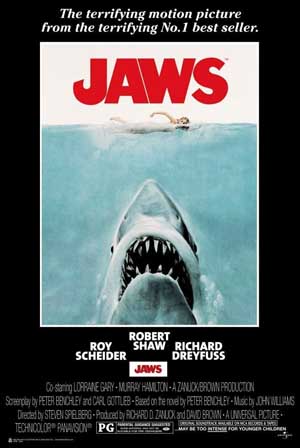
The genius of those notes permeating our nightmares. The summer of 1975. Fifty years ago, when the groundbreaking film, Jaws broke pop culture, invented the blockbuster, and became one of the most important and best American films of all time. Its composer and director poised to dominate Hollywood for decades.
Two notes.
Bah-dum.
You know it.
Bah-dum.
E. And then… F
It’s cool when you sit down at a piano and find it. A kid can play it. Sends chills down your spine. Every time. Sure, that’s because it adorns a movie about a killer great white shark lurking beneath the surface and nudging our ingrained fear of the unknown. But it is the music that connects those fears to our aural center and captures our imagination.
Before the film opens, before we see any people, we hear that music. Submerged, we swim, as the camera swims, through the water, as the creature must. The forward motion, the forever hunter. Then a beach party, where the music stops. Instead, there are now sounds of revelry from ghostly figures drinking beer and playing guitars, flirting and laughing and being young, invincible. Then the break of the young woman and the young drunken man chasing her, displaying the feral history of humanity – man chasing woman. She becomes naked and returns to the primordial waters, dives into the dark, cold, undulating sea. He cannot follow. She is alone, free. Also vulnerable, as we are, as we sit in the dark theater exposed to the visual/aural nightmare to come. The music returns, and then that tug, the yelp, the fear in her face, the terror she cannot see, we cannot see. The attack, the feeding, and she is gone. Under. Forever. Like a trip to Hades. A senseless, irrational death.
Bah-dum. Bah-dum.
The low keys.
E. And then… F.
Steven Spielberg was 27 years-old when he was chosen to direct a film based on the hottest book on the market, Peter Benchley’s tale of a giant great white shark terrorizing a New England island town; a clueless city-dwelling sheriff, a frightened townspeople and their sinister mayor, a curious young oceanographer and a grizzled fisherman with a shark grudge. Spielberg had directed just two films; a TV movie, a thriller, Duel, and a comedy, The Sugarland Express. Both promising. Nothing spectacular. Yet, he possessed the balls to insist on filming Jaws on the unpredictable fury of the Atlantic Ocean instead of a controlled environment. Forced to work with a mechanical shark that did not work, he filmed most of it without the shark. The music was the shark. That is how he got around making a shark movie sans shark. One of the great feats in cinema.
This is why Spielberg has said the music of Jaws is half the reason for its colossal success, as it became the biggest box office movie of all time that summer. In an era when popular music or more minimalist soundtracks reigned, the director insisted on an orchestra and tapped John Williams, who was 43 at the time with an Academy Award for the score of Fiddler on the Roof in his back pocket, to compose and conduct it. Having worked together on Spielberg’s previous film, they formed a comfortable duo, so much so that when Williams first played Spielberg those two notes, the director laughed. This was clearly a joke, he thought. It sounded like a child’s impression of approaching dread. Yes! This was Williams’ aim. Get us where we are the most vulnerable, as children. The theme is our monster under the bed, except it is under the water. Always the places we cannot see, so it can creep up on us. That is when Williams told Spielberg to listen closer as he played those two notes again, and then the ensuing notes that he later described as “primal, but fun” as a leitmotif for Spielberg’s shark. Spielberg got it, later saying, it was “a stunning symphonic achievement and a great leap ahead in the revitalization of film music as a foreground component for the total motion picture experience.” Thank goodness for second takes.
And what of the origin of those notes? All composers, especially those for film deconstruct, borrow and use footprints from the masters and other brilliant conveyors of narrative through the instrumental – the clever use of brass or wind or strings like bassoons and French horns and tubas and cellos to shift moods and hint at danger, joy, tension and release. I am reminded of a video clip of the composer sitting across from musician, Sarah Willis, as she plays for him the third movement of Beethoven’s Seventh Symphony, the look of surprise on Williams’s face, as it reveals the two notes that will inform and inspire, even by osmosis, what he would turn into the most recognizable theme in movie history.
The pressure on the cast, crew, producers, and mostly Spielberg to make Jaws a huge hit following the best-selling book’s hype and ensuing fervor for a film was immense. During its making, which has become as much legend as the film itself, there was turmoil and chaos. As the weeks turned into months, the cast bickered, as the boat, weather, ocean, and especially the mechanical shark failed to cooperate. Yet, the young director forged on with one mission, scare the hell out of America and then the world. And it is within Williams’ music that he sought refuge, as he knew it would help him soar above the limits of mere vision to bring his masterpiece home.
Two scenes in particular best illustrate how Williams’ score, and more to the point, his crucial theme underscores the brilliance of Jaws. Early in the film, two fishermen, motivated by a reward to catch the shark, use a pot roast wrapped in a thick, metal chain with a black inflatable tube attached to lure the shark. Williams’ theme begins, as the black tube courses out to sea, being clearly pulled by the invisible shark. The power of its momentum tears the dock asunder, taking one of the fishermen and the audience with it, into the shark’s territory – the water, the real villain of Jaws. The music swells and then recedes. As the fisherman frantically swims for safety, the dock, representing the shark, turns slowly and begins chasing him. And as the dock skims above the water and then increases in speed – the inanimate becoming the predator – the theme returns with a vengeance and into a frantic and desperate build. As the dock/shark gets closer and closer those two notes underscore its furious momentum until the fisherman barely makes it to safety and the chase is abandoned, reducing in volume to a single ominous bass note. This man may be safe, but the waters are not.
Later, when there is a massive scare, as the paranoid authorities are forced to comb the waters because the myopic capitalist mayor keeps the beaches open despite the threat of a killer shark, they try and get swimmers out of the water safely. Predictably, people rush wildly to get back to land. Spielberg ingeniously switches his shots from below the water to above the ensuing madness, intercutting flailing legs and arms, as if hors d'oeuvres for the shark. Throughout, there is no music. No theme. No danger? We are not conditioned yet. The audience assumes there is a shark, but we find out it is just two wise-ass boys with a fake shark fin. But just then, there are screams from the inlet, and the actual shark, presumed by the theme once again, lurks, firing up the drama and tension once more without ever seeing the shark.
Williams’ Jaws theme was so impactful and ubiquitous before the summer is out it is on the lips of everyone, many of us singing it as we leave jam-packed theaters with lines around the block in cities across America. At twelve, I am ushered in by a neighbor’s mom, who halfway through the movie becomes so hysterical with fear, I am seriously concerned for her health. Later, I would take my mom to see it and put my hands over her eyes during scenes I know will freak her out, but it doesn’t matter, the music tells her all she needs to know.
Released as a single, “Main Title (Theme from Jaws)” reached a staggering #32 on the Billboard Hot 100. What? It’s true. I bought it. Wore it out, next to my Stevie Wonder and Paul McCartney and Wings records. Ba-Dum/Ba-Dum was a certified hit. The soundtrack album reached No. 30 on the Billboard 200. Why? Well, in 1975, if you wanted to relive the thrilling moments of Jaws you needed the music, as we had no cable television, VHS tapes or certainly streaming where you can now see a film in a few weeks after its release. Soon, Jaws was gone. The theme, however, remained, like a distant echo. We needed that music to reignite our imaginations.
John Williams would go on to win his second Academy Award for Best Original Score for Jaws, and then create some of the most celebrated music themes in cinema history, not the least of which, the stirring theme to Star Wars, which evokes the heroic spirit in the listener as much as the Jaws theme instills terror. Spielberg would go onto reinvent blockbuster after blockbuster, becoming the most lucrative if not critically overlooked filmmaker of his or any time. And both he and Williams would continue to blow us away with visual/aural delights in among many other classics, Close Encounters of the Third Kind, Raiders of the Lost Ark, E.T. The Extraterrestrial, and Jurassic Park.
It all began fifty summers ago with a movie that was primed to be a smash and exceeded even the haughtiest of Hollywood prognostications. Jaws remains a definitive touchstone of American cinema. It has aged exceedingly well and because it reached our rawest emotions, it continues to dazzle and frighten and amaze. And as Spielberg has repeatedly and rightfully intoned, its theme, prologued by two notes, is its infinite calling card. A clarion for its infamous shark and the deep, dark infinite waters beneath our psyche.The online version in the Aquarian Weekly with additional media:
https://www.theaquarian.com/2025/07/09/profonde-musique-two-notes-that-changed-cinema-the-theme-from-jaws-at-50/
© James Campion 7.16.25
Follow at https://www.facebook.com/jamesbartolommeocampion/ X (@FearNoArt) and Instagram (@jamescampion).
James Campion is the the author of “Deep Tank Jersey”, “Fear No Art”, “Trailing Jesus”, "Midnight For Cinderella" and “Y”. +, “Shout It Out Loud – The Story of KISS’s Destroyer and the Making of an American Icon” + “Accidently Like a Martyr – The Tortured Art of Warren Zevon” and “Take a Sad Song…The Emotional Currency of “Hey Jude" and coming in 2025, “Revolution – Prince, the Band, the Era.”
The Connective Pop Music Tissue of Brian Wilson
James Campion 6.26.25
The Most Significant figure in Pop Music
Re-Discovering Boz Scaggs
James Campion
A Discussion with Jude Warne, Author of the Newly Released 'Lowdown – the Music of Boz Scaggs'
SLY STONE – 1943 - 2025
James Campion 6.11.25
Stone was a hustler and a visionary
Captain Fantastic and the Brown Dirt Cowboy at 50
James Campion 5.22.25
Elton & Bernie’s Masterpiece is My All-Time Favorite Album

no liability accepted by hackwriters.com or affiliates.