

Welcome • |
About
Us • |

26 Years Online
••• The International Writers Magazine - PROFONDE MUSIQUE
The Endearing Charm of The Prince of Darkness
• James Campion
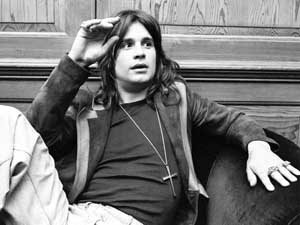
Ozzy never took his ascent from stumblebum nobody to the heights of rock stardom for granted...
Ozzy Osbourne died less than a week after the music world paid tribute to his career in a multi-million-dollar charity concert reuniting him with his legendary band, Black Sabbath. What a marvelous way to go out. We all should exit the mortal coil with people appreciating our work and influence and celebrating the whole thing in one giant blowout – even if it isn’t in front of thousands of screaming fans. The fact that this was afforded to someone who had consistently cheated death since his teenage years is nothing short of miraculous and the epitome of the charmed life lived by John Michael “Ozzy” Osbourne, a darkly morose figure born in atonal thunderous metal music; this broken and lonely kid from a dismal outpost of London, England, who endeared himself to millions. This was the secret sauce of Ozzy, a man completely devoid of artifice, despite the Dark Lord posturing, doom-struck lyrics, and madman antics. He lived in public as he did in private, as an immense fuck-this id, which, in the end, was a charm all its own.
I am sure by now every breathing music nerd has waxed poetic about Black Sabbath “inventing” heavy metal or Ozzy’s incredibly distinct whine of a voice that sent chills through most of the early 1970s into the 80s hard rock pantheon, and how his wildly successful solo career was resurrected by his wife, manager, and inimitable shrill loon, Sharon, the incredible corporate-sized majesty of the annual Ozzfests, and, of course, the reality show that transformed the bane of the moral majority into a lovably doting and babbling comedic figure. I shall not do that. I wish instead to concentrate on Ozzy’s uniqueness in rock music: his outlandish character set against his quaint personality, a childlike combination of perpetual confusion and joyful self-destruction forged in misery and the plight of youth.
Osbourne was a working-class kid. And became a working-class man, as much as any British rocker that preceded him. A bleak existence for anyone, especially someone with crippling dyslexia who suffered sexual and physical abuse at the hands of a parade of bullies since the tender age of eleven. Suicide attempts and deep undiagnosed depression led to the altar of rock and roll. Something Ozzy always embraced as a heroic rescue mission written in the stars. Playing the reluctant hero and aww-shucks maniac that gorged on life and the occasional bat overwhelmed his contribution to the evolution of rock music, including his stint as lead singer, front man, melodicist, and lyricist for Black Sabbath and as a solo artist, his stellar work with guitarist and co-songwriter, Randy Rhodes who died tragically at 25. Ozzy never took his ascent from stumblebum nobody to the heights of rock stardom for granted. He was beloved for always being that cheeky kid from Birmingham that wasn’t the way he was because of rock and roll but because he could be no other way in no other lifestyle than rock and roll.
This is how we balanced the very real damaging issues of booze, drugs, mayhem, and mythicizing that hounded Osbourne for most of his adult life with his innocent wonder in which he saw the world, reflected in his lyrics that continued to mine the human experience from pain, loss, war, paranoia, depression, and confusion, as well as an appreciation for the life of the spiritual. Black Sabbath may have played on the dark arts for image, but their songs, Ozzy’s songs, explored the depths of social and personal woes with a glimmer of guileless hope. He found that hope in song and stage. There was a perpetual look of distinct awe on Ozzy’s face that bespoke this loudly. He could sneer and shout and pose like evil incarnate but also smile the smile of someone who understood that his art sprung from a deep well. His laugh was knowing. It was charming.
There is this short video of him meeting with Paul McCartney backstage during one of Sir Paul’s many tours the past forty or so years. Dressed in his signature menacing black, a long mane of ebony hair streaked with blood read, Ozzy is in a childlike trance. Facing the celebrated ex-Beatle with his back to the camera, he gushes, “It’s so great to meet you, man.” As Paul, facing the camera, is seemingly uncomfortable and a bit flummoxed by Osbourne’s almost unintelligible genuflection, the once imposing Ozzy figure’s genuine admiration is endearing and true. “You guys made me start music,” he whispers. Paul, used to the celebrity mish-mosh, says something quaint and dismisses Ozzy as if a slobbering fan. But the key to the exchange is how much Ozzy appreciated being awakened by the Beatles to a new world order in his head, something he made sure enlivened his music and lyrics time and again.
In the end, Ozzy Osbourne’s contribution to the annals of rock is that if he didn’t invent something – heavy metal, dangerous front man, substance abusing crazy man – he embodied those traits, for good or ill, better than anyone; wholly, with no gray areas permitted. There was no “sort of” Ozzy. He was always a creature of force and will and humor and pathos that didn’t invent anything, really, because all of it came naturally. The world is filled with phonies and posers, but once in a great while you get a true instinctual being in an artform, and Ozzy Osborne was that. Ozzy was more Elvis Presley than the Beatles, really – that early 1955 Elvis that seemed to be running on a feral heartbeat of pure adrenaline and sexual abandon. Elvis, I have argued and still do, may have been the first shock rocker, a distinction Ozzy comfortably embraced. Eventually, Elvis lost his way. Ozzy never did. He only ever was that working-class kid from Birmingham.
And it is right he was sent off in a tribute to that purity. This idea that someone only needs to be who you are and not what the world wishes you to be is a comforting concept. Specifically, these days wherein everyone has a social media and online image to uphold. There is a liberation lesson in Ozzy for us all. Oscar Wilde famously said, “Be yourself, everyone else is taken.” Yeah, that was Ozzy Osbourne.
© James Campion 7.30.25
Follow at https://www.facebook.com/jamesbartolommeocampion/ X (@FearNoArt) and Instagram (@jamescampion).
James Campion is the the author of “Deep Tank Jersey”, “Fear No Art”, “Trailing Jesus”, "Midnight For Cinderella" and “Y”. +, “Shout It Out Loud – The Story of KISS’s Destroyer and the Making of an American Icon” + “Accidently Like a Martyr – The Tortured Art of Warren Zevon” and “Take a Sad Song…The Emotional Currency of “Hey Jude" and coming in *April 2025, “Revolution – Prince, the Band, the Era.”
Two Notes That Changed Cinema
James Campion
The Theme from Jaws at 50
The music moves ominously through dark waters with the predator.
The Connective Pop Music Tissue of Brian Wilson
James Campion 6.26.25
The Most Significant figure in Pop Music
Re-Discovering Boz Scaggs
James Campion
A Discussion with Jude Warne, Author of the Newly Released 'Lowdown – the Music of Boz Scaggs'
SLY STONE – 1943 - 2025
James Campion 6.11.25
Stone was a hustler and a visionary
Captain Fantastic and the Brown Dirt Cowboy at 50
James Campion 5.22.25
Elton & Bernie’s Masterpiece is My All-Time Favorite Album
Stephen Kellogg's Complicated Bonds of Friendship
James Campion 5.8.25
Stephen Kellogg is always writing songs. Even when he is without a guitar or a whistle on his lips, he is composing.
More reviews

no liability accepted by hackwriters.com or affiliates.